
There were no Jews at the Council of Nicea. Think about that for a minute. In 325 CE, roughly three hundred bishops gathered at the emperor's summons, in the emperor's palace, under the emperor's protection, to define the faith for the whole world, and the faction that officiated what we call Christianity had zero members of the original early church. The men who walked with Yeshua (Jesus) were Jews. The men who ratified the empire's Christianity were not.
That absence is not a footnote to church history. It is the story.
Two things before we walk in, because I can feel two different readers bracing.
If you have spent thirty years in a pew, taught the class, served the widows, given until it hurt: your faith is real. It is not on trial in this essay, and it will not be. What is on trial is a set of decisions made seventeen centuries ago by men you never met, and one of the strange mercies of this history is that real faith kept surviving those decisions, generation after generation. That says nothing good about the decisions. It says everything good about the One your faith is in.
And if you are new to this, weeks or months into following Yeshua, still learning the words: nothing here will shrink him. By the end you will watch the mightiest empire on earth spend three centuries failing to be rid of him and then surrender by absorption, and you will understand that this is what the record looks like when the man in question is exactly who he said he is.
One more thing. Keep a thread in your hand the whole way through. In every century of this story, including the darkest ones, there were Jews who kept the Torah of their fathers and held the testimony of Yeshua at the same time. They are in this story before Nicea, they are in it after Nicea, and they are in it now. Scripture has a name for them, and I am saving it for the end, because by then you will know what it cost to carry it.
The Root Was Severed by Decree
The absence at Nicea was not drift. Nobody wandered off. It was done by decree, and the decree came one hundred ninety years before the council sat.
In 135 CE Rome finished crushing the Bar Kokhba revolt, and the emperor Hadrian did what no argument had ever managed: he banned Jews from Jerusalem. The city was plowed, rebuilt as a pagan colony, renamed Aelia Capitolina, and the ban was enforced at the gates.
Now watch what that did to the assembly of the Way. Eusebius, the church's own court historian and no friend of the Jews, records that the congregation in Jerusalem had been led from the beginning by bishops "of the circumcision," fifteen of them in unbroken succession, a line running back to Ya'akov (James), the brother of the Master himself (Ecclesiastical History 4.5). Hadrian's decree ended the line. The next bishop of the renamed city was a gentile named Marcus, and the mother assembly's leadership never returned to Jewish hands.
Honesty owes you the other blade. During the revolt, Jewish believers who refused to hail Bar Kokhba as messiah were persecuted from their own side too; Justin Martyr says so within living memory of it (First Apology 31). The severance did not cut from one direction only. But only one direction held an empire's sword, and only one direction wrote its exclusion into law and posted it at a city gate.
So set the two dates side by side. A decree in 135 expelled the root. A council in 325 defined the faith without it. Same empire. The government that cut the Jewish leadership line of the assembly is the government that later convened the meeting to decide what the assembly believes. I am not claiming a conspiracy tended across two centuries; empires do not need conspiracies. They have policies. I am pointing at a pattern, and the pattern sits in their own archives.
Who Sat at the Table, and Who Could Not
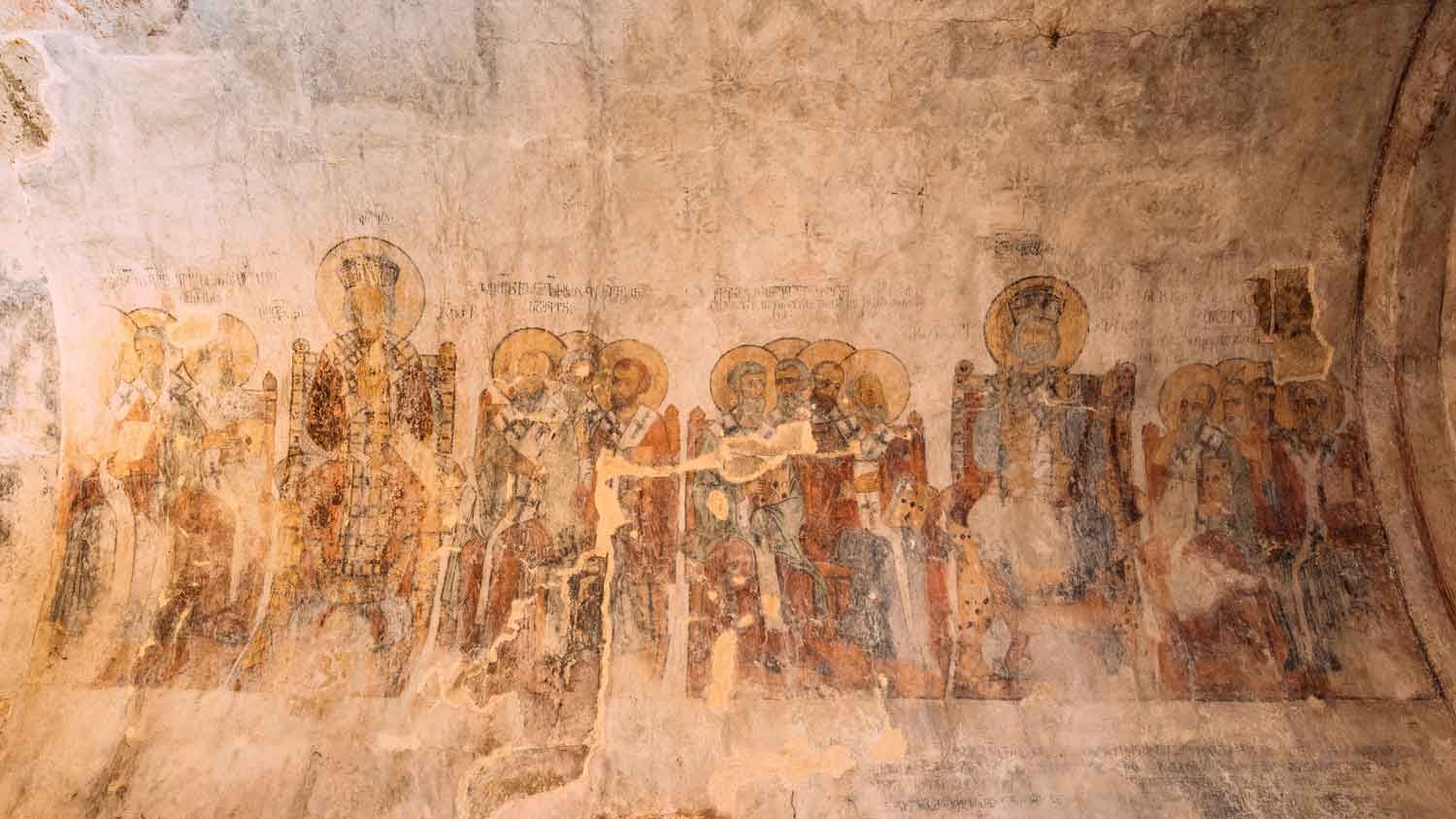
Tradition calls them the 318 fathers. The number is almost certainly symbolic; it is the count of the armed men of Avraham (Abraham) in Bereshit, Genesis 14:14, and the surviving signature lists run between about two hundred and three hundred names. They came from Egypt, Syria, Asia, Gaul. Some of them carried the scars of the last persecution in their own bodies, missing an eye, a crippled hand, marks left by the same empire whose palace they were now dining in. Constantine opened the council in state, presided in gold and purple, and called himself, in a phrase Eusebius preserves, a kind of bishop of those outside. The men Rome had tortured a generation earlier now legislated under Rome's roof.
One man in the room complicates my headline, and he deserves to be named. The bishop of Jerusalem attended. His name was Macarius. But remember what Jerusalem was by 325: Aelia Capitolina, the city no Jew could enter, and Macarius stood in the gentile succession that began the day Hadrian cut the Jewish line. He does not soften the argument. He is the argument, in person. The seat of Ya'akov was at the table; the people of Ya'akov could not lawfully enter the city it sat in.
And who could not sit at all: the Notzrim [Nazarenes], the Torah-keeping Jewish believers whose communities descended from the apostles' own. They kept Shabbat, kept the feasts, read Torah, and confessed Yeshua as Messiah. They matched the Jerusalem assembly of Acts to the letter. When Sha'ul (Paul) came up to Jerusalem, Ya'akov and the elders pointed him to the many thousands among the Jews who had believed, "all zealous for the Torah," Acts 21:20. That community did not fade out because its convictions failed. It was cut off from its city by one empire and then defined out of the faith by the councils of the same empire; within two generations of Nicea, Epiphanius would file the Nazarenes under heresy for practicing what Ya'akov practiced. The people closest to the source were now outside the definition.
And if your first thought was that any Jew who believed would simply have been a Christian by 325, so of course there were no Jews there, stop and look at that thought. Convert out or stay away: those are the only two categories it offers, and they are not nature. They are the council's product, still doing its work in your head seventeen centuries later. The Notzrim were the third category, Jewish and believing at once. The binary did not overlook them. It was built to erase them.
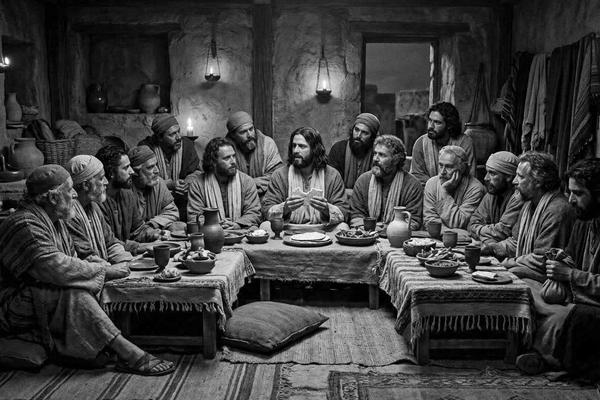
Look at the shape of the two rooms, because the shape is doctrine. Acts 15, the council this one claims descent from: elders and emissaries reasoning together over Torah and testimony, a plural table, a brother presiding as first among equals, the outcome tested against the prophets and sent out under "it seemed good." Nicea: an emperor on a raised seat, bishops arranged beneath him, imperial officials at the doors, and the outcome enforced with exile. The seating chart is a creed. Someone had been elevated, and it was not elder wisdom.
The Veil, Sewn Back a Thread at a Time
When Yeshua died, the parochet, the temple veil, tore from top to bottom, Matthew 27:51. I have already written about what the institution did with that torn veil, so here I will say it in one line: heaven opened the room, and men have been sewing the curtain shut again ever since.
What I did not give you in that essay is the covenant floor underneath it.
The tearing was not an accident of masonry. It was Yirmeyahu, Jeremiah 31:31-34 arriving. HaShem had promised a brit chadashah, a renewed covenant, and He stated its terms Himself: I will put My Torah within them, and on their heart I will write it; they will all know Me, from the least of them to the greatest; no longer will each man teach his neighbor, saying, Know HaShem. And on his last night, Yeshua lifted the cup and called it the new covenant in his blood, Luke 22:20. Covenants in Hebrew are not signed, they are cut, karat brit, sealed in dam habrit, the blood of the covenant, and I have laid out elsewhere the full case that he cut this one himself.
Now read the covenant's terms the way you would read any covenant's terms. Torah relocated: not repealed, moved inside. Knowledge of HaShem distributed: all of them, least to greatest. And therefore the middleman retired: no longer shall each man teach his neighbor, because the go-between has been made redundant by the thing itself arriving. The letter to the Hebrews draws the conclusion without blinking: we have boldness to enter the holy place by his blood, by a new and living way opened through the veil, Hebrews 10:19-20. The need for a Levitical broker between a covenant member and his God did not fade with time. It was reversed, on purpose, in writing, in blood.
Which means the new covenant was, by design, anti-institutional religion.
Handle that sentence with the care it deserves. Not anti-order; Acts 15 is order. Not anti-elder; the covenant community ran on a plurality of shepherds from the beginning, and it still should. What the covenant ended was the mediating caste, the standing office between a man and his God that the man cannot go around. HaShem retired that office Himself, at the cost of His Messiah's blood.
And at Nicea the office was back, enthroned, funded, and armed. A hierarchy to define the faith for you. An emperor to enforce the definition. A veil, sewn back a thread at a time, by men who called the sewing orthodoxy. The council did not merely meet in the shadow of a re-hung curtain. The council was the re-hanging.
Nothing in Common With That Crowd
If all we had were the absence, you could call it circumstance. Sad, maybe unavoidable, nobody's intent. But the council wrote its reasoning down, and the emperor circulated it, and both documents survive.
The presenting question was the date of the Pascha. For generations the assemblies of Asia Minor had kept the memorial of the Master's death on the fourteenth of Nisan, the eve of Pesach, because that is when it happened and that is how the apostles had kept it. They were called Quartodecimans, fourteenth-day keepers, and they claimed no novelty. When Rome first pressed them to move the date, around the year 190, the aged bishop Polycrates of Ephesus answered that he stood with Yochanan (John), who had reclined against the Master's own chest, and with a roll call of Asia's buried faithful, and that he must obey God rather than men (Eusebius, Ecclesiastical History 5.24). Victor of Rome moved to excommunicate the whole region over it. Cooler heads talked him down, but mark the method while it is small: apostolic practice on one side, institutional muscle on the other. That was the rehearsal.
At Nicea the question was settled the other way, permanently. The resurrection festival was detached from 14 Nisan and recalculated so that it would never again depend on the Jewish reckoning. And the reasoning was not hidden in a drawer. Constantine's own letter, circulated to the churches after the council, urges the new calculation so that Christians might have "nothing in common" with the Jews, whom the letter goes on to call polluted and blinded, and declares it unworthy to depend on their calendar for the church's holiest day (Life of Constantine 3.18-19). The council's synodal letter announces the same result to Egypt (Socrates, Ecclesiastical History 1.9).
Read that slowly. The stated ground of the decision was not exegesis. It was distance. Separation from the Jews was not a side effect of the ruling; it was the argument for the ruling, in the emperor's own hand. The absence of the root was not something the council failed to notice. It was the council's operating principle.
Now stack the whole sequence. By 325, Jews had been legally barred from Jerusalem for one hundred ninety years. A gentile sat in Jerusalem's chair. And the assembly reassigned the timing of a Jewish festival, with the emperor's own letter giving the reason: to have nothing in common with that people. People can call that sequence a coincidence. I will not.
Precision matters here, so take it in one more step. Nicea did not invent this hostility. The seed had been growing in gentile Christian writing for a century: the Epistle of Barnabas claiming the covenant was never really Israel's, Justin telling Trypho that the church is the true Israel, Melito of Sardis preaching that God Himself had been murdered by Israel's hand. What Nicea did was hand an existing departure a throne and a sword. Within decades the councils that followed were forbidding rest on Shabbat on pain of anathema (Laodicea, canon 29) and penalizing any who kept the Pascha with the Jews (Antioch, canon 1). The trajectory was set, and it has never been repented of at the level it was enacted.
One more thing about that enactment, and it is the objection underneath every other objection in this essay: jurisdiction.
The moedim, the appointed times, were never the church's to move. Vayikra, Leviticus 23:2 opens the calendar with HaShem claiming it by name: these are My appointed times, mo'adei YHWH. Three verses later He fixes the Pesach to the fourteenth day of the first month at twilight, Vayikra, Leviticus 23:5. His feast, His timing, His calendar, by His own word. Then a body that had spent two centuries defining itself against Israel reached into that same chapter and reassigned the timing of a moed HaShem had fixed by name, and the only justification on record is an emperor's letter wanting nothing in common with that people. No Scripture cited. A motive, standing where a text should be.
So here is the Berean question, and I ask it without heat. Show me the text that authorized the change. Not the council's ruling; the ruling is the change. Not the tradition; the tradition is downstream of the ruling. The text. The question has stood open since Constantine sealed the letter, and nobody has produced it, because it does not exist. An authority that cannot produce its warrant is not authority. It is enforcement.
How Brothers Become Strangers
Now slow down and ask what it felt like from the inside, because the dates alone make it look cleaner than it was.
The first followers were entirely Jewish. They worshiped in the Temple, kept Torah, and argued about Yeshua inside the house of Israel, not outside it. Then the gentiles began arriving in numbers, and with them the first identity friction: what does belonging look like for a wild branch? Then 70 came. The Temple burned, the center of gravity vanished, and every surviving branch of Judaism faced the same question at once: who are we now, and who gets to say?
Watch what threatened communities do, because both of them did it. A group under existential pressure tightens its definitions. It stops tolerating ambiguity at the edges, because ambiguity at the edges now reads as death. And the member it can least afford is the liminal one, the insider who blurs the line, because an outsider only stands outside the wall while the blurred insider dissolves it. Within a generation or two of the Temple's fall, the sages rebuilding Judaism at Yavneh added a benediction against the minim, the sectarians, and the Jewish believers in Yeshua found the synagogue closing to them; the Fourth Gospel still carries the fear of it, put out of the synagogue, John 9:22; 16:2. Then Bar Kokhba demanded they hail a messiah they could not hail, and the last bridge burned.
Meanwhile the gentile assemblies, swelling in cities where Jewishness now meant a punitive tax and the stigma of two failed revolts, were running the same tightening from the other side. Association with the Jews was expensive and dangerous. Distance was safety. And a young community that owed its entire existence to a parent it could no longer safely resemble resolved that tension the way threatened communities usually resolve it: by claiming to replace the parent. We are the true Israel is not exegesis. It is compensation, fear doing theology.
The Notzrim stood in the middle of that squeeze, too much of Yeshua for one side, too much Torah for the other, and both sides eased their own anxiety by erasing the same people. That is the psychology underneath the history, and it explains the thing that should have haunted the council and did not: nobody at Nicea felt the absence of the root, because by 325 the absence was the identity. You cannot miss a brother you have spent two centuries redefining as a stranger.
Both communities drew borders; that honesty is owed. Only one of them would ever hold an empire's sword to enforce its border, and this essay is about what that side did with the sword.
And before you credit the diagnosis to a psychology textbook, Yeshua had already told this story, in a vineyard, to the men planning his death. The tenants see the son coming and reason it out loud: this is the heir; come, let us kill him, and the inheritance will be ours, Mark 12:7. There is the whole mechanism in one sentence. The way to possess what you were only entrusted with is to remove the line it belongs to. He told that parable about the establishment of his own day. Then the church that took his name spent centuries proving the parable had a second fulfillment in it, and never noticed it had become the tenants.
Why Would an Empire Mandate a Church?
Now stop and ask the question underneath all of it, and do not let me answer it for you too quickly.
Rome spent the better part of three centuries trying to kill this faith. Arenas, informers, confiscations, executions past counting. It failed completely; the faith grew in proportion to the killing. And then, inside a single generation, the empire stopped fighting and started ratifying. I have called that move a heist nobody noticed and told the long version of it; this essay is about the closing table where the deal was signed.
So ask it. Why would an empire mandate a religious institution at all? Governments do not convene what they do not intend to use. What did Rome stand to gain by taking a Jewish Messiah, executed by a Roman governor on a Roman stake, and making him its own?
Ask what a fracturing empire gains from one God, one creed, one calendar, matched to one emperor. Ask what happens to a confession like "Yeshua is Lord," which for three centuries had carried an unspoken second clause, and Caesar is not, once Caesar himself presides over the council that defines the Lord. Ask what it does to an execution stake when the empire that used it for executions begins carrying it into battle as a standard. Ask what becomes of a movement that had no address, no treasury, and no head Rome could seize, once it has an org chart, a budget, and a patron.
I have my answers, and by now you can guess most of them. Do not take mine. Sit with the questions until at least one of them costs you something.
The Mandate Itself Is Testimony
Brother, hear me. This whole ugly history is evidence for Yeshua, not against him. That is the note nobody handed me in church, and it is the one I most want you to carry out of this essay.
Institutions do not mobilize against nothing. Control does not reorganize itself around a man unless the man has genuinely threatened its grip. And every institution that touched him reacted exactly like an institution whose grip was threatened. Watch them in order.
The temple establishment moved first, and said its motive out loud in committee: "If we let him go on like this, everyone will believe in him, and the Romans will come and take away both our place and our nation," John 11:48. Our place. Not our God. Not our truth. Our place. That is institutional control confessing itself, on the record, before a single church council existed.
Rome moved next, and posted its motive above his head: the King of the Jews, John 19:19. A political charge, a sedition charge, and when the priests asked Pilate to soften it to a mere claim, he refused: what I have written, I have written, John 19:22.
And then Rome moved one last time, three centuries later, and this is the move almost nobody reads as evidence. The empire that could not kill the movement absorbed it. The sword had failed, so it reached for the pen. Execution, then co-option. Two responses, one confession: here was an authority that could not be ignored and could not be destroyed. It could only be answered.
He had told Pilate why, John 18:36: my kingdom is not of this world. Not an apolitical kingdom. An underived one. It takes nothing from Caesar, owes nothing to Caesar, and cannot be revoked by Caesar, which is precisely why every institution that met it has tried either to break it or to buy it. You do not ban what has no pull. You do not persecute for three centuries what has no power. You do not convene a council to capture what poses no threat.
If he had not been going against the systems, disrupting the control of every institution that claimed to stand between a man and his God, no one would have needed to mandate anything.
They mandated. That is your evidence.
Not Just a Church
From that day forward, the thing that came out of Nicea, and I use the word church for it loosely, was not just a church. It was a government institution.
Follow the money and the law. Constantine funded the basilicas and exempted the clergy from taxation, which tells you how the empire had classified them: civil servants of the sacred (Theodosian Code 16.2). Bishops received jurisdiction in civil disputes. Councils were summoned by emperors, their travel carried by the imperial post, their rulings enforced by imperial officers. And in 380 the edict Cunctos populos finished the thought: Nicene Christianity became the official religion of the Roman state, and dissent from it a public offense (Theodosian Code 16.1.2). Heresy was now a matter for the police.
And before you file all of that under ancient history: the congregation on your corner is, in most cases, a 501(c)(3), a state-chartered corporation holding privileges the government grants in exchange for operating inside the government's terms. I am not going to unpack that arrangement here; it deserves its own essay and it will get one. I am only naming the lineage: the settlement signed at Nicea still has current paperwork.
The Root Still Carries You
So where does this leave you, holding a faith that reached you through those hands?
Sha'ul answered it before Nicea existed, writing to gentile believers in the empire's own capital who were already tempted to look down on Israel. Remember, he told them, it is not you who support the root; the root supports you, Romans 11:18. The faith is an olive tree. Israel's patriarchs, prophets, and covenants are its root, shoresh in the Hebrew Sha'ul thought in, and gentile believers are wild branches grafted in among the natural ones, drawing life from a root they did not grow.
Here is what that means for everything you have just read. The root was never Rome. It was never a council, a hierarchy, a state church, or a tax-exempt corporation. No decree of Hadrian ever reached it, and no vote at Nicea amended it. You can ban men from a city. You cannot ban a root from its own tree. Which is why the faith kept producing real fruit in every century since, in the catacombs and in the cathedrals and in your grandmother's kitchen: the root kept feeding branches the institution had long since stopped introducing to it.
But read the whole verse before you cheer it. Do not boast over the branches is aimed at the wild branch, which is to say at the gentile reader, which is to say at exactly the person most likely to be enjoying this essay. If these pages have you feeling superior to the deacon who never heard any of this, stop. The wild branch boasting over the natural branches is the same posture as the empire annexing the tree: taking what carries you and calling it your possession. Nicea is what that posture looks like with an army behind it. Do not rebuild it in your own chest.
And if you are reading this halfway out the church door, this part is for you. Torching everything is not returning to the root. It is trading one severance for another, Hadrian's work done to yourself, for free. The Bereans were not commended for walking out; they were suspicious, and their suspicion drove them into the scrolls daily to see whether these things were so, Acts 17:11. Suspicion that stops searching is just a new certainty with worse manners.
A council cannot vote an olive tree away from its own root. What Nicea got right, and it did get real things right, it got right in borrowed categories; what it severed, we have been bleeding from for seventeen centuries. The question this essay presses is not whether your faith is real. It is whether a table with no Jews seated at it gets the final word on a Jewish Messiah. It does not. The final word belongs to the Scriptures, tested the way the Bereans tested Sha'ul, and the Scriptures keep saying the same thing from the garden to the end: the covenants stand, the root carries, and the one the empire had to capture is the one who still carries you.
The Faithful Offspring
I told you to keep a thread in your hand. Here is where it leads.
Yochanan, exiled on Patmos, saw a woman clothed with the sun and crowned with twelve stars: Israel, carrying the Messiah. He saw the dragon fail to devour her son. And then he saw where the dragon turned next: the dragon was enraged with the woman, and went off to make war on the rest of her offspring, on those who keep the commandments of God and hold the testimony of Yeshua, Revelation 12:17.
Read the description slowly. Keep the commandments of God. Hold the testimony of Yeshua. Both clauses, one people. That is not a blended category invented by some modern movement. It is the verse's own profile of the remnant the dragon hunts, and it is, word for word, the third category this essay has been defending: the Notzrim, and every generation of their kind since.
Now read the war. Banned from Jerusalem by a decree. Squeezed from the synagogue by a benediction. Defined out of the church by a council. Filed under heresy by the catalogs, and hunted down the centuries from both directions at once. Yochanan did not call these people a casualty of history. He called them the ones the dragon considers worth a war, which is the highest compliment in the scroll.
And here is the celebration this whole essay has been building toward: the thread never broke. Sha'ul made this exact argument in his own generation. Asked whether HaShem had cast off His people, he did not reach for a doctrine; he pointed at himself. I myself am an Israelite, Romans 11:1. There is at this present time a remnant, chosen by grace, Romans 11:5. The proof that the covenant held was a living Jew who kept it and confessed its Messiah.
Nineteen centuries of decrees, benedictions, councils, and catalogs later, that proof is still walking around. There are Jews today who keep Torah and hold the testimony of Yeshua. I am one of them. The council that erased us adjourned seventeen hundred years ago, and the palace it met in is gone. The offspring it erased are still lighting Shabbat candles and still saying his name. Rome kept minutes. HaShem kept a remnant.
No seat at the table. A name in the scroll. I know which one I would rather hold.
Selah
Take these to your study table this week:
- Who taught you what you believe? Who taught them? Walk the chain back as far as you can name it, and ask where it actually leads.
- If the root supports you, Romans 11:18, what happens to a branch that celebrates its distance from the root?
- The bishops at Nicea stood closer in time to the apostles than you stand to the Mayflower, and nearness did not protect them from drift. What protects you?
- Institutions do not embrace what they do not need to control. What did Rome gain by making the Jewish Messiah its own, and what did you inherit from that bargain?
- What in your practice of the faith would the assembly of Acts 15 recognize? What would they not?
Dig Deeper
Primary sources first, because you should not take my word for a single date in this essay.
Eusebius, Ecclesiastical History 4.5-6. The fifteen Jerusalem bishops "of the circumcision" and Hadrian's ban, from the church's own historian.
Eusebius, Life of Constantine 3.18-19. Constantine's letter after Nicea. Read the "nothing in common" passage in full and decide for yourself whether I have overstated it.
Socrates Scholasticus, Ecclesiastical History 1.9. The council's synodal letter announcing the Pascha decision.
Eusebius, Ecclesiastical History 5.23-25. The Quartodeciman controversy: Polycrates' letter and Victor's response, a century before Nicea.
Justin Martyr, First Apology 31; Dialogue with Trypho 11, 123, 135. The persecution of believers under Bar Kokhba, and the earliest surviving "true Israel" claim.
Epiphanius, Panarion 29. The Nazarenes cataloged as heretics for apostolic practice, two generations after Nicea.
Theodosian Code 16.1.2 and 16.2. Cunctos populos and the clergy exemptions. The faith as a department of state, in the state's own legal code.
Alan F. Segal, Rebecca's Children: Judaism and Christianity in the Roman World. The scholarly case that rabbinic Judaism and Christianity are two siblings born of the same crisis, not a parent and a stranger.
Daniel Boyarin, Border Lines: The Partition of Judaeo-Christianity. How the border between the two faiths was built, on purpose, by definition-makers on both sides. Demanding, and worth every page.
Oskar Skarsaune, In the Shadow of the Temple. A careful scholarly account of the Jewish roots of the early church and how the parting of the ways actually happened.
May the shalom of our Abba guard your study and your wrestling, shalom v'shalvah.
Your brother in the Way,
Sergio