
📬
Sign Up for Our Amazing Newsletter!
Writing result-oriented ad copy is difficult, as it must appeal to, entice, and convince consumers to take action.
Thank you! Your submission has been received!
Oops! Something went wrong while submitting the form.

Welcome To The Table
Thank you! Your submission has been received!
Oops! Something went wrong while submitting the form.
Scripture
We Turned Jesus Into a Thing
Fourteen ninety-nine for a fifty pack, at the largest Christian bookseller online. The price tag is the most honest thing in the building. How the person became inventory, what got sold off in the trade, and the question the men at the front owe an honest answer.

Scripture
The Gospel You Were Handed. Was It Real?
The answer most of you will get is true in nearly every sentence, and the word covenant is not in it. A dare, the paragraph it produced, and what was standing in its place before any of us got here.
Scripture
True Worshipers
Colossians 3:16 sent me looking for the psalms, hymns, and spiritual songs of Scripture, from the Song of Moses to the song of the Lamb. Who we worship matters, and so do where, when, why, and how.
Scripture
I Have Been Screaming the Wrong Word
Rome mediated, and burned the men who handed out keys. Protestants gatekeep. For years I aimed the first charge at the second church. This is the correction, and the word Yeshua actually used.
Scripture
The Heart Hires the Mind
Romantic logic, the logic that defends Western Christianity, and the prophet who diagnosed both.
Scripture
Working under the anointing
Bringing the creativity of the Creator into your daily life
Scripture
There Were No Jews at Nicea
There were no Jews at the Council of Nicea. That absence was not an accident; it was decreed by one empire, defended in the emperor's own letter, and enforced for centuries. What the severance cost, who carried the thread anyway, and why the whole record is evidence for Yeshua, not against him.
Journal
We needn't see in a mirror dimly
Paul was quoting the Torah in Numbers 8
People
Titles He Refused
Yehoshua accepted every name that described work he was doing and refused every name that would have frozen that work into a chair only one person could sit in, which is why calling him a rabbi hands him both an office that did not yet exist and one of the three titles he explicitly declined. The refusal was a governing rule about how his people would organize themselves rather than a gesture of modesty, and the movement that preserved it abandoned it within three centuries.
Scripture
He Lived It for You, Not Instead of You.
Christianity says Yeshua lived a perfect life as a substitute for yours. Read tamim in Hebrew and a different picture appears: not a spotless record waiting to be transferred, but a whole man shown to you. A word study, a doctrine with a birthday, and the question almost nobody asks about what the life was actually for.
People
The Room in Jerusalem
A leadership rule preserved in Acts makes presence at the Jordan under Yohanan ha-Matbil the threshold qualification for a seat among the Twelve, which means the senior cadre of Yehoshua's movement came out of the Immerser's camps rather than off the Galilean shore. Once that personnel question stands on its own evidence, the wilderness vocabulary saturating the Fourth Gospel stops looking like literary borrowing and starts looking like native speech, which makes the Johannine corpus the last surviving record of how that milieu talked.
Scripture
Wise in Their Own Eyes: What Scripture Knew Before Dunning and Kruger
The robe does not confer the text. It usually just ends the argument early. A Berean reading of why the credentialed teacher and the man too afraid to speak are the same failure, and why the beit midrash is the cure for both.
Scripture
The Torah David Longed to Keep
Psalm 119 is not a praise poem. It is one hundred and seventy-six verses of a man who loved the Torah and could not keep it, begging to be changed from the inside. The new covenant is the answer to that cry, and from Yeshua's own mouth to the last letter of Yochanan, the Brit Chadashah is standing exactly where the psalm stood.
Scripture
Ramifications of the New Covenant
Learning to know [yada] the Lord
1 / 10


Trending
The Gospel You Were Handed. Was It Real?

28
min read
The Heart Hires the Mind
12
min read
There Were No Jews at Nicea
23
min read
Support our work

Fresh Off the Press
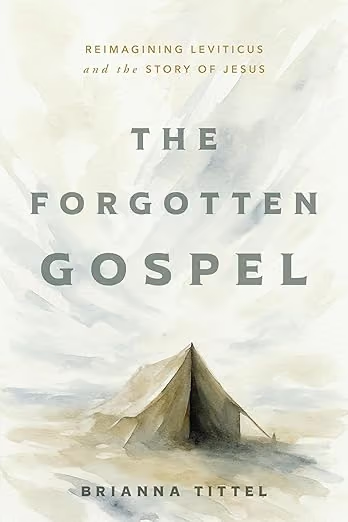






Welcome to the table
Featured Posts
We Turned Jesus Into a Thing
9
min read
The Gospel You Were Handed. Was It Real?
28
min read
True Worshipers
6
min read


