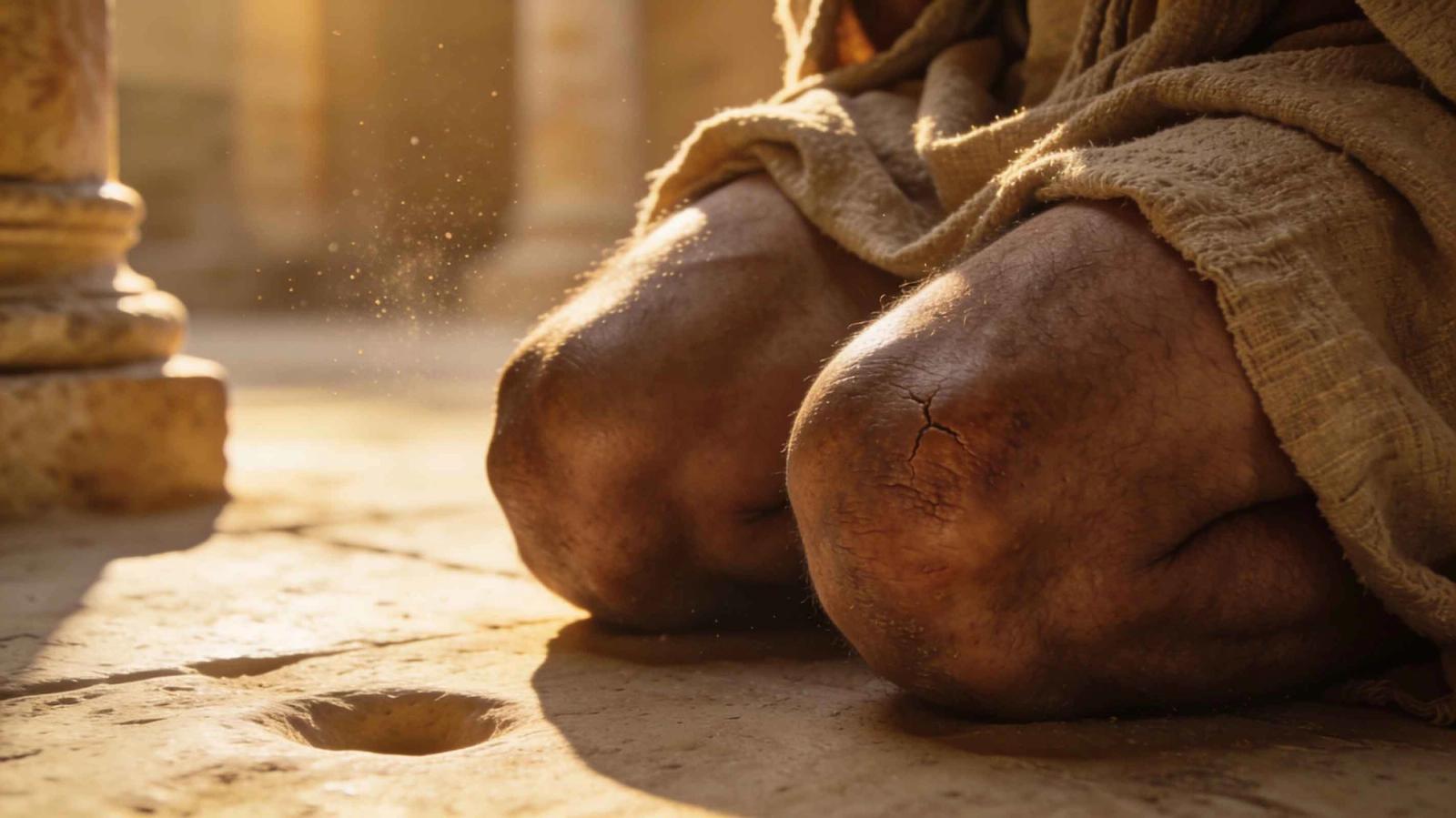

I want to begin this meditation on Ya'akov ha-Tzaddik, or James the Just One, by considering a story about his knees.
Around 150 CE, an early Nasorean chronicler named Hegesippus wrote about Ya'akov, and he wrote as an admirer. And a good deal of what he says carries the high shine of devotion on it. [[1]] I would like for us to set the reliability question aside for one moment, and ask a different question. Let's ask what a community chooses to preserve about a man when it can only preserve a memory little-by-little.
The Nasorean chronicler did not preserve his oratory. No speech of Ya'akov's survives in the movement's memory. Oddly, they preserved his kneecaps. Hegesippus reports that Ya'akov knelt so often and for so long on the stone that the skin over his knees went hard and thick, like the callus on a camel's leg. [[2]] That is among the first qualities that his own people wanted a stranger to know about him.
A callus behaves something like a ledger. In a very literal sense, a callus is the body keeping an honest account of what a person did over and over across decades. You grow one by showing up and doing the work, over and over again. The detail tells us that the men and women who knew Ya'akov understood him primarily as someone who came back, and came back, and came back, to the same floor, and asked for mercy on a city that had killed his brother.
Hold that image while everything else assembles around it. Every other fact in this essay is a fact about a working man, and the work left marks.
The House He Came From
Ya'akov came out of Beit Yosef, the household at Nazareth, and in the reconstruction we are following that household belongs to the Netsarim, the watchers, a Yahwist settlement holding the Davidic line and holding it deliberately.
Later generations gave his family a name: they called them the Desposyni, the ones belonging to the Steward. [[3]] The title travels for centuries. It is a household designation rather than an office, and it carries the assumption that this family held something the movement could not simply reassign.
He was also, on every account we have, a Nazarite for the whole of his life. [[4]] The Book of Numbers sets out the ordinary shape of the vow. No wine. No razor. No contact with the dead. Most men who took it took the vow for thirty days and then released it with a haircut and a set of offerings at the sanctuary. Ya'akov took it and never put it down.
Understand what that means socially. The vow is not private devotion. It is a recognizable public status in a small country, and it announces itself before a man speaks. His hair announced it. His refusal of the cup at a table announced it. The chief priests knew what he was from across a courtyard.
One branch of the tradition remembers him in language that goes further still. The Gospel of Thomas has Yehoshua tell the assembly to go to Ya'akov the Just wherever they are, because heaven and earth came into being on his account. [[5]] That is a second-century saying from outside the canonical stream, and it is useless as biography. It is priceless as testimony to standing. Somebody, somewhere, sometime relatively close to the founding generation, thought this man held the world together.
The Climb
Now walk with him, because the walk feels like a small study in where the character sits.
He goes up to the Temple in the morning, as he did most mornings for thirty years. He crosses the lower city and comes to the southern staircase, wide and shallow and cut so that a crowd must slow down and look up as it climbs. He passes the immersion pools clustered at the base, where pilgrims purify before ascending. He goes in through the Huldah gates, up through the tunnel, and out onto the platform into the light and the noise and the smell of the morning offering.
And there, every single day, stand the men who did it.
Yosef Kaiafas held the high priesthood until about 37, so the arithmetic of a thirty-year stare does not work on him alone. The arithmetic works on the house. Hanan ben Shet put five sons and a son-in-law into the vestments across those decades. [[6]] The captains of the Temple guard served at their pleasure. The treasury officials answered up the same chain. The concessionaires trading in the Royal Stoa held their licenses from the same family. A later rabbinical lament remembers that house for its whispering and for the clubs its servants carried. [[7]]
So Ya'akov climbs the steps and sees the clubs. He sees the men holding them. He sees the sons and the kinsmen of the man who convened a night court during a festival week and delivered his brother to a Roman prefect for execution. He watches them handle the shewbread. He hears them pronounce the blessing over the people. He watches them take their portion.
He does this in the morning. Then he does it again the next morning.
He did not raise a mob. He did not withdraw to the wilderness and curse them from a safe distance. He climbed the steps, and he knelt on the floor until his knees changed shape, and then he went back down into the city and got to work.
The Tables
The work is the part that gets skipped, and it is the part that mattered most to the people who ate because of it.
Ya'akov essentially ran a distribution system. The Acts of the Apostles describes it in pieces across three chapters, and the pieces fit together into something any warehouse manager would recognize on sight. Members liquidated their assets and holdings and then brought the funds to the assembly. The assembly then pooled them together into a central storehouse. Funds were issued daily, and the standard governing any issue was the need of the person receiving. [[8]]
Then the system did what all growing systems eventually do: it broke at a seam. The sixth chapter of Acts records the failure without embarrassment. The widows of the Greek-speaking households were getting shorted against the widows of the Aramaic-speaking households in the daily service of the trapeza. The response from the Apostles was administrative rather than devotional. The assembly appointed seven men over the trapeza and delegated the function to them. Moreover, the seven carry Greek names, which means the solution was brilliantly staffed out of the population that had raised the complaint in the first place. [[9]]
Read that sequence again as a logistics problem, because that is what it is. Intake, pooling, daily issue, a service failure reported by an underserved class of claimant, an audit, a structural remedy, a staffing decision that puts the aggrieved party inside the system. This is not almsgiving. This is an anti-poverty apparatus with an escalation path. By my count, it is the first successful implementation that any text records within the tradition.
And it was Ya'akov who presided over it. Paul, writing to the assemblies in Galatia and with no reason to flatter, names him first among the pillars when he lists the men whose decisions bound the movement. [[10]] By the time Paul sat down with those pillars to negotiate terms, Ya'akov had been running Kehilla ha-Ebyonim in the open for something close to fifteen years. [[11]] He was doing it inside an occupied capital, under the eye of the priestly administration and the Roman garrison, without a license and without a patron.
Consider the audacity of such a man as that.
The Receipt
The most physically specific thing anyone ever tells us about Ya'akov sits in a passage most readers skim.
Paul arrives in Jerusalem under a cloud of rumour. Ya'akov hears him out and then hands him an instruction. Four men in the assembly have taken Nazarite vows and cannot afford the offerings owed at release. Paul is to pay their expenses. Paul is to shave with them. Paul is to be seen doing it. [[12]]
Consider the shape of that decision. The man who never released his own vow sends the movement's most controversial figure up to the sanctuary to cover four other men's haircuts and four other men's sacrifices. The gesture costs money, which answers the charge of contempt for Torah with an expense the whole city can verify. It puts Paul's body in the Temple, which answers the charge of abandonment with an eyewitness. It relieves four poor men of a debt they could not clear, which is the actual business of the assembly.
Ya'akov solved a political crisis with a receipt. That is a specific kind of mind. It is the mind of an administrator who has learned that in a hungry city, an argument settles nothing and a paid bill settles a great deal.
What He Wrote Down
The letter that carries his name runs under eighteen hundred words in Greek, and it reads differently once you know whose hands it came from.
Let all of you conduct yourselves this way. Be quick to shema, to studiously listen. Be slow to dabar, to hand down pronouncements. Give no room at all to ka'as, to rage. The ka'as of the human being cannot produce the equitable justice of the Guardian. [[13]]
A comfortable man could write that and mean very little by it. Ya'akov wrote it while walking past his brother's executioners every morning of his adult life. He is not recommending calm to people who have nothing to be angry about. He is reporting a finding from thirty years of field testing. Rage will not build the distribution system. Rage will not staff the tables. Rage will not get bread to a Greek-speaking widow in the fourth quarter of the city. Equity has to be administered, and rage cannot administer anything.
And then look at how he closes. The letter does not end with a benediction. It ends with a referral protocol. If any of you is sick, call for the elders of the assembly, and let them pray over him and anoint him. [[14]] A man who ran a mercy corps ended his one surviving document by telling people where to go for care. He was still working on the last page.
The Killing
He died in 62, and our best witness for it despises the movement he led, which is exactly why the testimony holds. [[15]]
Josephus gives the mechanism with no reverence whatever. The procurator Festus died in office. His replacement, Albinus, had not yet arrived from Rome. Ananus the younger, freshly installed in the high priesthood and reading the gap correctly, convened a council of judges, brought a charge of Torah violation against Ya'akov and several others, and had them stoned.
Then comes the sentence that should stop every reader cold. The most scrupulous men in the city objected. They sent word to Agrippa. They sent riders down the road to intercept Albinus before he reached the capital. Agrippa removed Ananus from the high priesthood after three months in office. [[16]]
Hold the full shape of that outcome. The High Priest killed him, and killing him cost the High Priest his office. The same city that had let his brother go decided, thirty years on, that it would not let this one go. Something had changed in Jerusalem across those decades, and the thing that changed it was a man on his knees in the morning and at the tables in the afternoon.
Three Hundred Years Later
The final witness for the character of Ya'akov never heard his name and would have hated him.
In 362, the emperor Julian set out to restore the old temples of the empire and found almost nobody interested. He wrote to a priest in Galatia in something close to bewilderment, complaining that the Galileans feed their own poor and then feed his as well, and that everyone can see it, and that his own side does nothing comparable.[[17]]
Julian is a hostile witness under no obligation to be generous, and he testifies that the system still ran. It outlived the Temple. It outlived the war. It outlived the empire's memory of why it had ever mattered. Three centuries after seven men were appointed over the tables in Jerusalem to fix a complaint from a group of overlooked widows, a Roman emperor could not compete with the machine that fix produced.
So come back to the knees.
The callus is the whole argument in miniature. A man walks the same road every day for thirty years. He faces the same men. He carries the same grief. He refuses the wine and he keeps the vow and he kneels on the stone until his body records it. Then he stands up and goes down into the city and makes sure the widows eat.
That is where authority came from in the Commonwealth of the Way. It came from custody. Ya'akov held the thing, and he held it in daylight, and he held it long enough to leave marks on himself. When we ask why the assembly in Jerusalem listened to him, the answer is not mystical and it was never obscure. They could see his knees.
Notes for the Nerds
[[1]] Hegesippus, Hypomnemata, preserved in Eusebius, Historia Ecclesiastica 2.23.4-7. Hegesippus wrote around 180 CE and survives only in quotation. His portrait is devotional and should be read as a record of how the movement remembered Ya'akov rather than as a transcript of his habits. The memory itself is the evidence in view here.
[[2]] Eusebius, Historia Ecclesiastica 2.23.6, quoting Hegesippus. The passage also reports that Ya'akov drank no wine, ate no meat, allowed no razor to touch his head, used no oil, and visited no bathhouse.
[[3]] Julius Africanus, preserved in Eusebius, Historia Ecclesiastica 1.7.14. Africanus writes in the early third century and reports that the surviving kin of the household were still called by this name in his own day, and that they carried their genealogy from memory after Herod destroyed the public registers. The claim about the registers is speculative; the currency of the title is documented.
[[4]] Hegesippus in Eusebius, Historia Ecclesiastica 2.23.5-6. Note that the description bundles Nazarite markers (no razor, no wine) with claims of priestly access to the sanctuary, which no Nazarite vow confers. Readers should treat the vow itself as [inferred] and the sanctuary access as [speculative]. Numbers 6.1-21 sets out the ordinary form of the vow.
[[5]] Gospel of Thomas, logion 12. The saying is second-century and stands well outside the canonical stream. It is offered here as testimony to Ya'akov's standing in one branch of the tradition rather than as a saying of Yehoshua.
[[6]] Josephus, Antiquities 18.35 and 18.95 for the tenure of Yosef Kaiafas. On the family, Antiquities 20.198, which reports that Hanan ben Shet had five sons who each held the office, an outcome Josephus calls unprecedented.
[[7]] Tosefta Menahot 13.21, echoed at Babylonian Talmud Pesahim 57a. The lament is a later rabbinical composition and preserves a grievance rather than a contemporary report.
[[8]] Acts 2.44-45 and 4.32-35. The phrase rendered here as issue by need is kathoti an tis chreian eichen, distributed according to whatever need any person had.
[[9]] Acts 6.1-6. The complaint concerns the daily diakonia, the service of the tables, and the seven appointed to it carry Greek names, which suggests the assembly staffed the fix from the aggrieved population.
[[10]] Galatians 2.9. Paul names Ya'akov first among the three he calls styloi, pillars, and the ordering is his own.
[[11]] Galatians 1.18 and 2.1 supply the interval on Paul's own testimony. Acts 15 places the deliberation over the terms of admission in the same period. The figure of roughly fifteen years is a reconstruction from these two witnesses.
[[12]] Acts 21.17-26. Numbers 6.13-20 specifies the offerings owed at the completion of the vow, which is why the four men needed a sponsor.
[[13]] James 1.19-20, rendered here through the Shuva B'rit Translation. The Greek orge stands over a Hebrew ka'as, and dikaiosyne over tzedek, which in a covenantal register carries the sense of equity administered rather than righteousness possessed.
[[14]] James 5.14-16. The instruction names the presbyteroi of the assembly and pairs anointing with prayer over the sick person.
[[15]] Josephus, Antiquities 20.200-203. Josephus calls him the brother of Yehoshua who was called Christos, James by name. The passage is generally accepted as authentic and shows none of the Christian retouching visible elsewhere in the Antiquities.
[[16]] Josephus, Antiquities 20.201-203. Those who objected are described as the citizens most exacting about the law. Agrippa II removed Ananus after three months in office.
[[17]] Julian, Letter to Arsacius, High Priest of Galatia, written around 362 CE. Julian complains that the Galileans support their own poor and then support his as well, and that everyone can see his side doing nothing comparable.