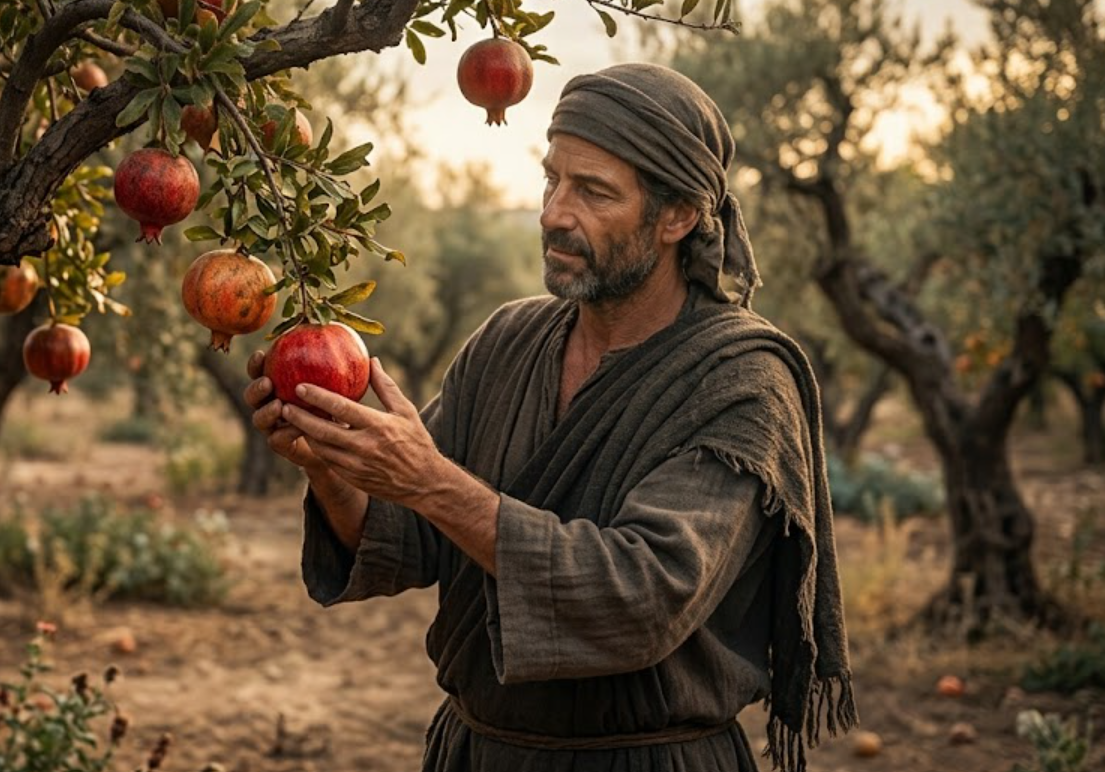

Paul wrote a short list near the end of his letter to the assemblies in Galatia. You may know it by heart.
But the fruit of the Spirit is love, joy, peace, patience, kindness, goodness, faithfulness, gentleness, and self-control. No law stands against things like these. Those who belong to the Anointed One, Yehoshua, have crucified the mortal body along with its passions and its appetites. If we live by the Spirit, let us also walk in step with the Spirit. Let us not grow conceited, provoking one another and envying one another.
Paul’s Letter to the Assemblies in Galatia | chapter 5:22-26 | Shuva B’rit Translation
Most readers today hear that list as a portrait of a person’s inner life. Love is a feeling. Joy is a mood. Peace is a calm mind. On that reading, the Spirit works on the heart, and the heart is where you look for results.
I want to offer an older reading. Whatever else can be said about Paul of Tarsus, we can confidently say that he was raised as a Yahwist, a devotee of YHWH raised on the Torah and the Prophets. He read those texts and traditions in Greek, and every word on his list already had a long working life there. In those ancient texts, to talk about love is to speak about what feeds and clothes a stranger. To talk about joy is to describe a feast with the widow at the table. Peace is a household that owes nothing and fears no one.
Moreover, Paul shows us his source. Eight verses before the list, he sums up the whole Torah in one line: love your neighbor as yourself. That line originally comes from Leviticus 19. A few verses after the list, he tells the Galatians to carry one another’s heavy burdens. He tells them to share all good things with their teachers. He tells them to do good to everyone. He ties his list to obligations, and he leaves the details relatively vague and open to broad interpretation.
On the other hand, groups like the Ebyonim filled those details in. Ebyonim is Hebrew for “the dispossessed ones.” This community was the Torah-keeping assembly gathered in Jerusalem around Ya’akov, who you know as James, the brother of Yehoshua. They lived by the b’rit, the Covenant between YHWH and Israel. They found its terms in the Torah, the written instruction of Moshe, read in the renewed light of Yehoshua’s teachings.
For the Ebyonim, each word on Paul’s list in Galatians named something you could see, count, and eat.
A Few Words Before We Begin
Start with fruit. Paul’s Greek word is karpos, and the Hebrew behind it is peri. Both mean a crop. Leviticus 26 says that when Israel keeps the Covenant, the land gives its produce and the trees give their fruit. Yehoshua says you will know a tree by its fruit. Fruit is a public test. You walk up and check what grew.
Next comes Spirit. Paul’s Greek word is pneuma, and the Hebrew is ruach. Both mean breath or wind. Isaiah 32 describes what happens when the ruach arrives.
The ruach pours out on us from on high, and the wilderness becomes an orchard. Justice settles in the wilderness, and tzedakah makes its home in the orchard. The work of tzedakah will be shalom.
Tzedakah also needs a quick gloss. This word means the fair and scheduled redistribution of goods and land-capital that the Covenant requires. In a way of thinking, Isaiah wrote a fruit of the Spirit passage centuries before Paul did - and his version has soil in it.
So, this essay makes three kinds of claims, and I will tell you which kind you are reading. A textual claim means a source says so in plain words. An inference means several sources point the same way. A reconstruction means my best account of how the Ebyonim would have understood the list. Every reconstruction here rests on the first two.
We will take the nine words three at a time, in Paul’s order.
The Table: Love, Joy, Peace
Paul’s first word is agape, love. In the Greek scriptures, agape translates the Hebrew ahavah. Deuteronomy 10 tells us what ahavah does. YHWH loves the stranger, it says, by giving him bread and a cloak. Then comes the command: you must love the stranger too. The text defines love with two items you can hold in your hands.
Leviticus 19 does the same work at greater length. This is the chapter Paul quotes. Its famous line about loving your neighbor sits among very practical company. Leave the edges of your field for the poor. Pay your worker before the sun sets. Keep honest scales. In that chapter, love is the name for the whole package.
Ya’akov makes the point with a scene. A brother and sister arrive without clothes or food. Someone tells them, “Go in peace, be warmed and filled,” and hands them nothing. Ya’akov asks what good that does. All of this is textual.
The second word is chara, joy. The Hebrew is simchah. Deuteronomy commands simchah, and that already tells you something. You can command a feast far more easily than a mood. Three times a year Israel gathers to eat before YHWH. Deuteronomy 16 names the guests: your sons and daughters, your servants, the Levite, the stranger, the orphan, and the widow. The command covers the whole list. Nehemiah 8 adds an instruction. Eat the rich food, drink the sweet wine, and send portions to anyone who has nothing ready.
Joy has an everyday form too. In Matthew 6, Yehoshua tells his hearers to stop worrying about food and clothing. He gives a reason. Seek first the Commonwealth and its tzedakah, he says, and these things will come to you. I read that as a promise about a community. Where the sharing works, the worry ends. That reading is an inference. Acts lends it support, since it shows the Jerusalem assembly pooling its goods and eating together with gladness.
The third word is eirene, peace. The Hebrew is shalom. Its root verb, shillem, means to pay back and to make whole. Exodus uses that verb for restitution. Shalom is what you have when the accounts are settled. Leviticus 26 paints the picture. Keep the Covenant, and the land gives its crop. You eat your fill. You lie down, and no one makes you afraid. Micah adds every family under its own vine and fig tree.
Look again at Ya’akov’s scene. The empty blessing there was “Go in peace.” Ya’akov treats shalom without bread as a counterfeit.
The Ledger: Patience, Kindness, Goodness
The next three words belong to the world of lending. That may surprise you. In a farming economy, one bad harvest sent a family to a neighbor for a loan. What the lender did next decided whether that family kept its land.
Paul’s fourth word is makrothymia, patience. The Greek scriptures use it for a famous Hebrew phrase, erekh appayim, which means slow to anger. Exodus 34 lists it among the qualities of YHWH. It describes someone with every right to collect who chooses to wait.
Yehoshua tells a story in Matthew 18 about a servant who owes a fortune. The servant falls to his knees and begs, “Have patience with me, and I will pay you back.” His word is Paul’s word. Torah builds that patience into the calendar. Deuteronomy 15 cancels debts every seventh year. The Hebrew name for that event is the shemitah, the release. Deuteronomy 24 tells a lender to return a poor man’s cloak by sunset, because he sleeps in it.
Ya’akov shows the worker’s side. He tells unpaid field hands to be patient like a farmer waiting for the precious fruit of the earth. He has just warned the landowners that the wages they held back are crying out.
The fifth word is chrestotes, kindness. In everyday Greek it suggested something useful and good to have. In the Greek Psalms it translates tov, good, in the sense of bounty. Psalm 65 says YHWH crowns the year with it at harvest. Psalm 85 says, “YHWH will give what is good, and our land will give its fruit.” The Greek for “what is good” in that line is chrestotes. The Greek for fruit is karpos. Paul’s two words share a verse in the Psalms, and the verse describes a harvest.
Yehoshua gives the human version in Luke 6. Lend and expect nothing back, he says, because the Most High is kind even to the ungrateful.
The sixth word is agathosyne, goodness. Nehemiah 9 uses it for the “great goodness” Israel enjoyed. The passage lists a rich land, dug wells, vineyards, olive groves, and fruit trees. Proverbs 22 adds a phrase worth learning. A generous person has a “good eye,” and he shares his bread with the poor.
I would separate the two words this way. Kindness is the yield, and goodness is the sharing of it. The verses are textual. The distinction between them is my inference.
The Assembly: Faithfulness, Gentleness, Self-Control
The seventh word is pistis. English Bibles often render it as faith, and readers hear belief. The Hebrew behind it is emunah, from a root that means firm. Our word amen comes from the same root. In Exodus 17, Moshe’s tired hands stay emunah, steady, until sunset. In 2 Kings 12, the Temple pays its builders through foremen and finds them so reliable that it never audits them, because they deal in emunah. In 1 Chronicles 9, the word names an office. The chief gatekeepers hold an emunah, a trust, over the storerooms. Emunah describes a person you can lean on, especially with other people’s goods.
The eighth word is prautes, gentleness. The Greek scriptures use it for the Hebrew anav, which means lowly or bowed down. It is a close cousin of ani, poor. Numbers 12 calls Moshe the most anav man on earth. Psalm 37 promises that the anawim, the lowly ones, will inherit the Land. Yehoshua repeats that promise in Matthew 5.
The prophets pair the anawim with the ebyonim again and again. Isaiah 29 says the anawim will find fresh joy in YHWH and the evyonim will celebrate. Evyonim is the name the Jerusalem assembly carried. The link between the words is textual. The step from the word to the community’s name is an inference.
The ninth word is enkrateia, self-control. This one is different, and I owe you that. Greek philosophers prized the word. The noun never appears in the Greek Torah or the Prophets. It has no Hebrew twin.
The nearest thing in Torah is a set of limits on the person who harvests. Leave the corners of the field. Leave the dropped sheaf. Rest the land in the seventh year. Gather one measure of manna per person. Exodus 16 reports that those who gathered much had nothing left over, and those who gathered little had enough. If the Ebyonim had needed a Hebrew home for enkrateia, I think they would have pointed there. That is a reconstruction, and it is the thinnest one in this essay.
Paul deserves credit here. In 2 Corinthians 8, while raising funds for the poor of Jerusalem, he quotes that same manna line. He names the goal as equality.
What Paul Left Open
Paul ends his list with a short sentence. No laws stand against things like these. I take him at his word. Torah does more than permit these nine things. It schedules them. Gleaning comes every harvest. Wages come every sunset. Release comes every seventh year. In the fiftieth year comes the yovel, the Jubilee, when land returns to the families who lost it.
Paul wrote to assemblies drawn mostly from the nations. They lived far from the land. He gave them the words, and he gave them the duty in general terms. Earlier in the letter he reports that the leaders in Jerusalem asked one thing of him. They asked him to remember the poor. He says he was eager to do it.
The Ebyonim held the full instruction. Acts describes the result in Jerusalem. The assembly pooled its goods. It fed its widows every day. Acts says there was no needy person among them. That sentence echoes Deuteronomy 15, which promises that no evyon will remain among you when the Covenant is kept.
Here is my reconstruction. The Ebyonim would have heard Paul’s list as a harvest report. They would have agreed with every word. Then they would have walked you out to the field.
Where This Reading Could Be Wrong
The Hebrew scriptures also speak of the heart. Deuteronomy 6 commands love with all your heart. Psalm 4 says YHWH put more joy in the singer’s heart than others have when their grain and wine overflow. Those verses are textual, and they count against any claim that the tradition ignored inner life.
I think the tradition joined heart and hand. Deuteronomy 15 is the clearest case. It warns the lender against hardening his heart and shutting his hand in the same breath. It warns him against a mean thought as the year of release draws near. The poor man in that passage is an evyon. Torah speaks to the heart at the exact moment the loan is on the table.
A second challenge comes from the Community Rule, a handbook found among the scrolls near the Dead Sea. Its fourth column lists the ways of the spirit of truth. The list includes anavah, erekh appayim, and lasting goodness. A Torah-keeping separatist wilderness community wrote a list much like Paul’s, and it reads like a list of required character traits for initiates. That same handbook requires members to bring all their property into the common fund. Its traits lived inside a mandatory shared economy.
Third, no Ebyonim comment on Galatians survives. Fourth, I have treated the Jerusalem assembly of Acts as the Ebyonim. Many scholars would call that identification an inference at best.
What I Am Claiming
Some of this is textual. Each of Paul’s words, except the last, translates a Hebrew word with concrete, material uses in the scriptures he read. Paul quotes Leviticus 19 just before the list and names obligations just after it.
Some of it is inference. Paul chose his words knowing their history. The sayings of Yehoshua and the letter of Ya’akov use them in the same material sense.
The rest is reconstruction. The Ebyonim would have measured each fruit by what reached the vulnerable, marginalized, and dispossessed.
A Question to Carry
Paul and the Ebyonim both agreed with Isaiah on what the Spirit grows. Suppose a stranger walked through your own community looking for that fruit. What would you be able to show him?
Recommended Reading
Hans Dieter Betz, Galatians: A Commentary on Paul’s Letter to the Churches in Galatia (Philadelphia: Fortress, 1979).
John M. G. Barclay, Obeying the Truth: A Study of Paul’s Ethics in Galatians (Edinburgh: T&T Clark, 1988).
Mark D. Nanos and Magnus Zetterholm, eds., Paul within Judaism (Minneapolis: Fortress, 2015).
Luke Timothy Johnson, The Letter of James, Anchor Bible 37A (New York: Doubleday, 1995).
William L. Moran, “The Ancient Near Eastern Background of the Love of God in Deuteronomy,” Catholic Biblical Quarterly 25 (1963).
Douglas E. Oakman, Jesus and the Peasants (Eugene: Cascade, 2008).
Michael Hudson, And Forgive Them Their Debts (Dresden: ISLET, 2018).
A. F. J. Klijn and G. J. Reinink, Patristic Evidence for Jewish-Christian Sects (Leiden: Brill, 1973).
Discussion
0 repliesNo replies yet. Be the first to respond.