

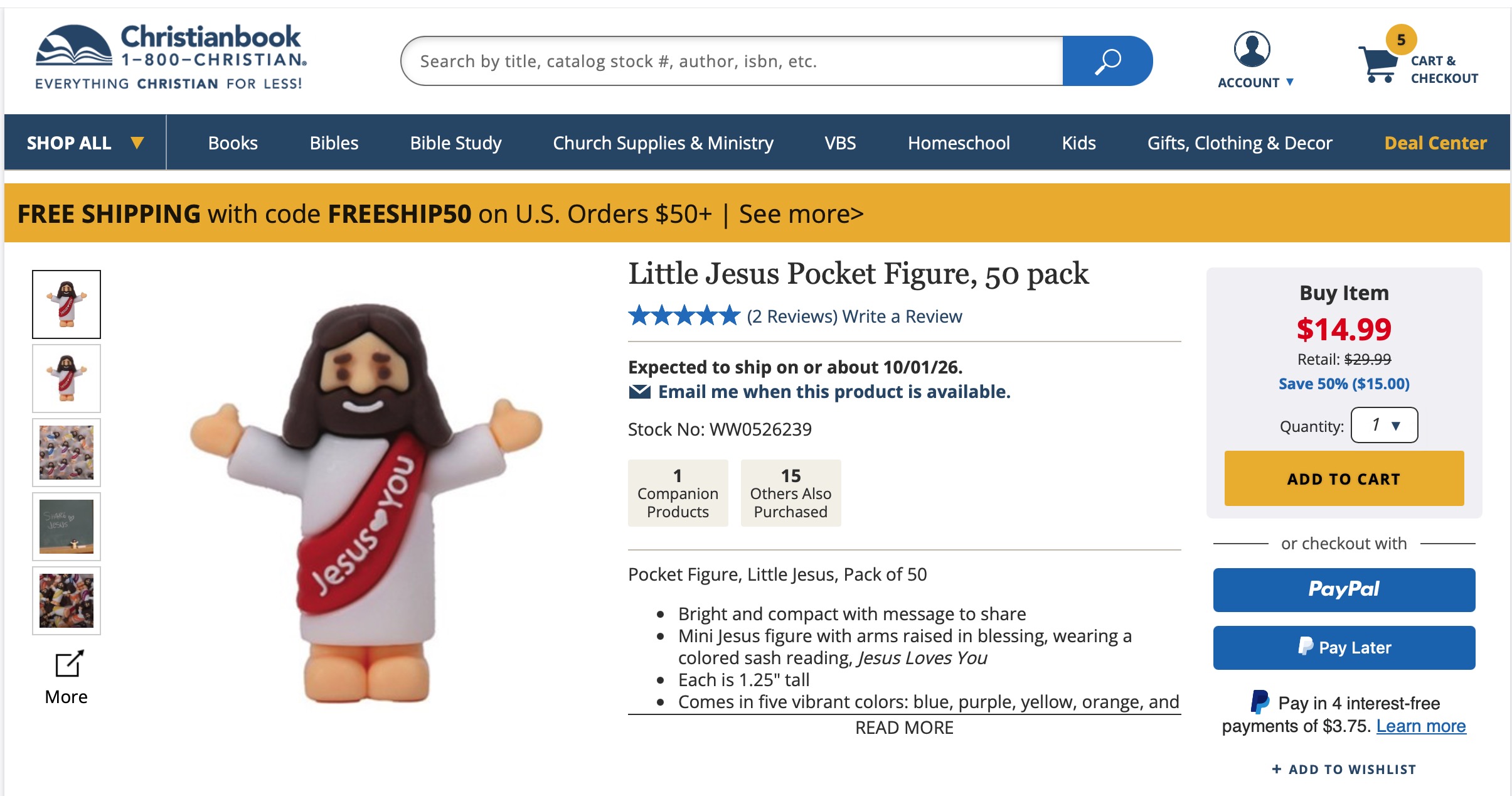
Fourteen ninety-nine. Marked down from thirty. Free shipping if you spend fifty.
That's what he costs now, at the largest Christian bookseller online. Little Jesus Pocket Figure. Fifty pack.
Fifty. Not one, held carefully. Fifty in a box, handed out at the door like breath mints. Nobody buys fifty of a person. And this isn't a warehouse mistake. It's the model, sitting in plain sight with a price tag on it.
The Business Model in Plain Sight
Somewhere along the way we stopped introducing people to a person and started moving inventory. The decision became a transaction: say the words, sign the card, close the sale. The testimony became packaging, before and after, sanded smooth, no rough edges left in it. And the brand became a substitute for the presence.
Here's why nobody objects. A product asks nothing of you. You can set a figure on a shelf and walk away, and it will be exactly where you left it. You cannot shelve someone who knows you. Ownership feels like intimacy and costs nothing, and that's the trade we took.
I want to be careful here, because this isn't a metaphor. It's a filing status. Almost every church in this country is a 501(c)(3). An entity. Payroll, a mortgage, a copier lease, a youth pastor with a family to feed. None of that is sinful. All of it is expensive. And an entity with fixed costs needs a repeatable revenue event on a seven day cycle.
So you need something to move. If the thing you're moving is a person, the person gets shaped to sell. Softened. Made agreeable. Trimmed to fit the room.
And you can tell what got trimmed by what never survives onto the product. The Yeshua who looked at a rich and devout young man, loved him, and told him to sell everything he had, Mark 10:21. The Yeshua who watched His crowds swell and turned around to thin them: "whoever does not bear his own cross and come after Me cannot be My disciple", Luke 14:27. That man does not move units. What survives the cut is the agreeable half: he loves you, he has a plan, he asks nothing this week. The product is not a different person. It is the same person with the demands filed off.
The pocket figure is just the honest version: it has the price printed on it. Sunday has a price too. We just call it giving.
Before anyone calls this modern, listen to the charge HaShem filed against the shepherds of Israel: "You eat the fat, you clothe yourselves with the wool, you slaughter the fat ones, but you do not feed the sheep", Yechezkel, Ezekiel 34:3. Same arrangement, different century, better lighting.
And here's what makes it worse. The man at the front has read Ezekiel 34. He's preached it, probably at a men's breakfast. He knows the shepherds who feed themselves get named. He just never once considered that the passage might have his name in it.
So pick one. Either your pastor doesn't know his Bible, or he knows it and sells anyway. Which would you rather be true? Hold that question and don't answer it. It was never yours to answer, and before this piece is done I'm going to hand it to the man it belongs to.
Why Nobody Checks
The Bereans didn't take the word of Sha'ul (Paul) for anything. They went home and searched the Scriptures daily to see whether the things he said held, Acts 17:11, and understand what that means: there was no New Testament to check him against. They had the Tanakh, Moshe (Moses) and the prophets, and if Sha'ul's claims had not held against the text that already existed, the Bereans would have dropped them. If they audited an apostle against Moshe, you can audit the man with the lapel mic. That isn't rebellion. It's the only posture Scripture ever commends toward a teacher.
And notice why nobody does it. It isn't laziness. Look at the room: one man elevated, one microphone, everyone else in rows facing forward. The synagogue was a room built for disagreement, and we replaced it with theater seating and a sound system, then called the silence unity. You can't cross-examine a monologue, and you're never given the floor to try. I walked every inch of that architecture in I Have Been Screaming the Wrong Word, and that essay asked who keeps custody of the text. This one asks what the custody is for. Follow the fixed costs and the bolted chairs to the same counter: nobody checks, and that's why the fifty pack sells.
Mars Hill paid a marketing firm $210,000 of church money to buy at least eleven thousand copies of its own pastor's book onto the New York Times bestseller list. The pastor came out of it fine; he always does. That's not the scandal. The scandal is that the machine worked exactly as designed, and the sheep paid for it.
But that's the loud version, and loud versions are convenient. They let you point and say I would never. The quiet version opens its doors this Sunday in ten thousand buildings, and nobody gets indicted, because it's legal, it's normal, it's mortgaged. There's a church down the road from me that won't publish a financial statement. It doesn't have to.
Love Reaching for a Handle
Now here's the defense, and it isn't stupid. The incarnation was tangible. God did not stay abstract. He took on flesh, and people touched Him, ate with Him, put their hands in His side. So why not something to hold?
I understand the impulse. I do. You wanted your kid to have something in his pocket at school. You wanted the man on the corner to walk away with more than a folded tract. That isn't stupidity. That's love reaching for a handle.
But a handle is exactly what He refused to be. The incarnation gave us a person we could touch, not an object we could own. The defense proves the theft.
And the figure isn't a symptom. It's the problem rendered in plastic. What happens on Sunday is that He gets handed to you in a manageable form: ninety minutes, controlled lighting, a version of Him that fits the format and asks nothing on the drive home. Somebody just molded the thing we were already doing. The doll didn't corrupt the church. The church made the doll in its own image.
And He has been in a building where this happened before. He walked into His Father's house, found the sellers set up in it, made a whip with His own hands, and put the entire operation on the floor. Listen to the charge He filed while He did it: "do not make My Father's house a house of trade", John 2:16. The Greek word is emporion, a market, and our word emporium is its child. I have shown you that scene before for what it blocked. Look at it this time for what He called it. When the Gospels finally show His anger turning physical, what set it off was retail in the holy place.
I Never Knew You
Then Matthew 7, and read who's talking. Not atheists. Not the man asleep in the back row. People with output: "Lord, Lord, did we not prophesy in your name, and cast out demons in your name, and do many mighty works in your name?", Matthew 7:22. They did. He never disputes the resume.
He says, "I never knew you", Matthew 7:23.
The Greek is γινώσκω (ginosko), and it isn't knowledge about someone. It's acquaintance, the knowing between two people who have actually met. Underneath it sits the Hebrew yada, the word Scripture uses for the knowing between a husband and a wife, the word the whole covenant runs on. They had the works, the vocabulary, the platform, the merch. They never had Him. You can accumulate everything adjacent to Yeshua (Jesus) and never once be known by Him.
So here's what got sold off. Reverence went first, because you cannot revere what fits in your pocket. Awe requires something larger than you, and we shrank Him to fit the shelf, the sermon slot, the sash that says he loves you in case you forgot.
Intimacy went second. A relationship costs you exposure. Being known means being seen, and being seen means changing. A figure never asks, and that is precisely why it sells.
Submission went last, and it was never going to survive the first two. You don't submit to inventory. You manage it.
One more thing about the price, because the number in the first line of this piece should have been familiar. The last time a man priced Him, the price was thirty, Matthew 26:15. Zecharyah saw the appraisal coming five centuries out and recorded HaShem's own verdict on it: "a magnificent price, at which I was valued by them", Zecharyah, Zechariah 11:13. He told them to throw it to the potter. It is the only place in Scripture where He tells you what He thinks of His market value, and He would not keep the money. We put him on markdown from it.
To the Men at the Front
And now the word I promised, not to the pew this time. If you carry a title in the building, pastor, elder, deacon, the man who orders the fifty pack for the outreach table, hear me. I'm not asking whether you love Him. I'm asking you to sit alone with one question and answer it with nobody else listening: has Yeshua become a commodity in your hands?
You already know the tests. If He stopped drawing a crowd tomorrow, which parts of your week would survive? When you chose this Sunday's passage, did you weigh what it would do to the people or what it would do to the giving? When did you last hand the room the floor and let it weigh you, the way the Bereans weighed an apostle? Would you publish the books if nobody made you?
And the question I took away from your congregation earlier is yours now. Do you not know that Ezekiel 34 has your name in it, or do you know and keep the arrangement anyway? Nobody in the pews can answer that. You can, and you already know which it is.
Here's the mercy, and it's sitting in the same chapter that indicts you. When HaShem finishes with the shepherds, He does not post the position again. "I myself will feed My sheep, and I myself will cause them to lie down, declares Adonai YHWH", Yechezkel, Ezekiel 34:15. The Shepherd's job was never open. Yours is the one that's left: equip the saints, hand out the tools, make the introduction, and get out of the doorway. Stop moving product. Start making introductions. It will cost you, and it will be the first transaction in the building that doesn't need a price tag.
Check your shelf. Not the plastic one.
Your heart is the shelf.
Selah
Walk your house tonight and count the things that carry His name. Then ask which of them has ever asked anything of you.
If everything with His name printed on it left your home tomorrow, how much of Him would remain? Be honest about the difference between the two inventories.
If you hold the microphone: of the four tests in this piece, which one did you read fastest? Sit with why.
And this week, introduce Him to someone with empty hands. No tract, no figure, no invite card. Just what you actually know of Him. What would you say?
May the shalom of our Abba guard your study and your wrestling, shalom v'shalvah.
Your brother in the Way,
Sergio