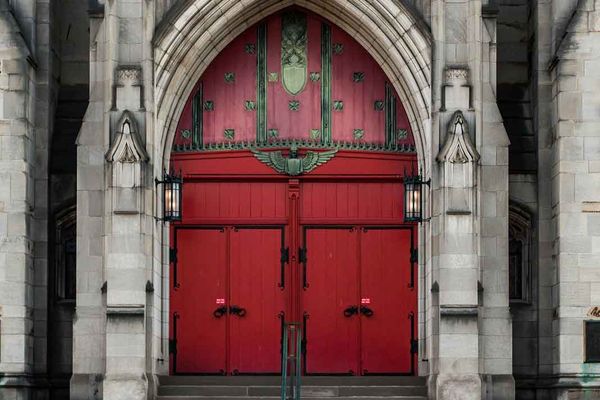

If you were to travel back to the year 50 CE and somehow find one of Paul’s churches, you wouldn’t find a Gothic-style building with pews, an altar, organ, and the like. Instead, if you were able to find them at all, given that the largest might have been around 100 people, although the vast majority would have held much less, you would find them in people’s homes. These probably would have held dinners in the homes of wealthier members, in order to be able to hold the larger groups. Imagine yourself in a city like Thessalonica, which might have had a population around 100,000 or a few thousand less and you happen to stumble upon a group of fifty Jesus followers. What might you have thought about them and their meetings?
The Greek word ekklesia was used both by non-Jewish Greeks and Jews to describe assemblies, either of the city (polis) or of a gathering of Jews in a particular city. In a Jewish context, the word overlapped with sunagoge, the root of the modern word, synagogue. Associations also existed in Judea in the form of the Pharisaic havurah, a small group of disciples who dined together and learned Torah and the Pharisaic tradition of interpreting it and, perhaps most importantly, strictly upholding the laws of ritual purity. In the Greek context, it could refer to the assembly of a city or an association of like-minded individuals, either based upon worship preferences (devotion to a particular deity), trade associations, or ethnic-based associations, like Jews had in their assemblies in Greek cities. These associations were made up of members, who drafted by-laws (nomoi) that dedicated participation in the group and who received benefits. These were quite popular in the ancient world, because they built up a sense of community and relationship-building among peers. Jewish synagogues or assemblies in the Diaspora were somewhat similar to the ethnic-based association, as they could also be based upon trade, such that Jews of the same profession could form a synagogue or association for camaraderie in a new city. Some larger cities, like Rome, had more than one Jewish association, probably based on neighborhoods to enhance the social connections people could make in those groups.
By far, the most common term used to describe early Jesus followers’ assembly was ekklesia, although the assembly was called a synagogue once (James 2:2). Paul does not describe many details about the assembly or how it was run. If it was somewhat like other associations from Antiquity, it would have had membership dues, regular dinners, some organizational structure, would have provided for funerals for its members, among some other benefits. Some of this describes what we know about early Jesus followers’ assemblies. For example, the Corinthian assembly held regular dinners, perhaps on Saturday or Sunday night (depending on how you read 1 Corinthians 16:1–6), but there were problems of the treatment of certain members at these dinners (1 Corinthians 11), which prompted Paul to address in his letter to them (among many other issues). We know there was extensive fundraising among these groups, but we’re not sure how membership was determined. In Corinth, there were probably two levels of membership, the “strong” and the “weak”. How you understand those terms is a matter of intense debate among Pauline scholars, but from the use of the terms, we can determine there were at least two types of members. As mentioned, we know there were regular dinners, at least in Corinth but probably elsewhere, and there was some sort of organizational structure. In Philippi, Paul mentions the overseers and servants (episkopos and diakonos). These might have been offices held by members for a length of time. Think of a modern synagogue, which has a president, vice-president, board of directors, etc. Your local synagogue president is, in fact, a “bishop” but just didn’t know it!
The most common way the Jesus believers’ assembly would meet would be in a regular meal. Paul describes these meals as the “Lord’s meal”, giving it a sacred purpose, beyond general socializing and relationship-building. This was a real meal with bread, wine, and a variety of other foods common at the time, figs, dates, fish, lentils, honey, etc. Paul emphasized that their dinner was for the Lord (i.e. Jesus) and not meant to worship other gods, as it was common at the time to offer libations to pagan gods during the meal.
Imagine yourself as a first-century Jesus believer. You think of your assembly (“church”) as a weekly meal among close friends, even family, where your stomach is filled and your mind and heart are filled with spiritual conversations, discussions about the teaching of Jesus and Paul, laughter, sharing moments of happiness and grief with fellow believers. This aspect of Christianity was lost in the institutionalization of the church in the fourth century and beyond. However, this aspect of spirituality was not lost in rabbinic Judaism, where regular family gatherings for Shabbat and holiday dinners are the norm, as well as the home-based festivals of Hanukkah and Passover are the more common celebrations among American Jews. Christians would do well to recover some elements of the first century assembly to enhance the home-based aspects of religion that are lacking in modern practice.