
Sergio DeSoto recently posted a short provocation that I haven’t been able to put down. He pointed at the word ekklesia, the Greek term our Bibles translate as “church.” He argued that when Yehoshua spoke of building his ekklesia, he was reaching back to Sinai. He had in mind a people called out, delivered, and gathered before the divine presence. Then Sergio asked his readers to look at the sign outside the building where they worship and wonder whether it matches.
I answered him in the comments, and the answer has kept growing in my own mind. This essay is where it grew to.
My claim is simple to state.
The earliest assemblies of Yehoshua’s movement were working institutions of Torah-based self-governance.
They kept common treasuries. They chose their own officers by vote. They fed their widows, housed their travelers, and guarded their funds against the greedy. They also inherited these practices. The practices came from a family of covenantal charters that had been refined across roughly two centuries before the first assembly met in Jerusalem.
To see that inheritance, we have to dig. The word “church” sits on top. Beneath it lie three older words and three older documents. Let’s start with the words.
The Hebrew Beneath the Greek
The Hebrew scriptures have a name for Israel standing together before YHWH. That name is qahal. Deuteronomy remembers the day at Horeb as yom ha-qahal, the day of the assembly. On that day, in Deuteronomy’s telling, the whole people gathered at the mountain, heard the voice from the fire, and received the Covenant. Qahal is the Sinai word. Sergio was right to reach there.
Readers who know some modern Hebrew may expect the word kehillah. It appears in the Hebrew scriptures only twice. Deuteronomy 33:4 calls the Torah the inheritance of the kehillah of Jacob. The second occurrence is the one I love. In the fifth chapter of Nehemiah, the poor of Judah cry out that they have mortgaged their fields and sold their children’s labor to pay their creditors. The creditors are their own kinsmen. Nehemiah rebukes the nobles, and then he convenes a great kehillah against them. The assembly forces the creditors to return the fields and stop charging interest. So the rarer word shows up at a debt revolt, and I think that tells us something about what an assembly was for.
Greek-speaking Yahwists translated these scriptures in the centuries before Yehoshua, and they needed Greek words for qahal. They chose two. In Genesis through Numbers, they often reached for synagōgē, a gathering. From Deuteronomy onward, ekklesia becomes the more common choice. The day of the assembly at Horeb became, in Greek, the day of the ekklesia. Both Greek words carried the same Hebrew freight into the first century. A Yahwist of Yehoshua’s generation could call the gathered people a synagōgē or an ekklesia and mean the same body.
The Epistle of James shows this happening. In its second chapter, James imagines a rich man in gold rings and fine clothes walking into “your synagōgē.” The poor man in shabby clothes gets told to stand at the back. James is furious about it. Three chapters later, James tells a sick member to call for the elders of the ekklesia. One Yehudan letter, written to one set of communities, uses both words for the same assembly. No first-century reader would have heard a change of subject. Somewhere between that letter and our own century, the two words split into two religions. One word became the synagogue, and the other became the church. The split belongs to later centuries, and the letter’s first readers knew nothing of it.
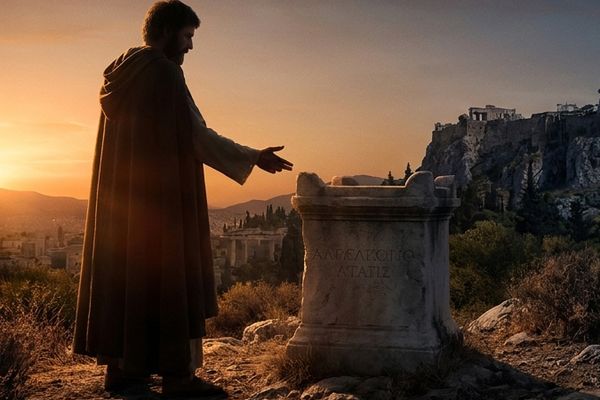
The Greek word brought one more layer with it, and that layer matters a great deal. In a Greek city, the ekklesia was the citizens’ assembly. At Athens it met about forty times a year on the hill called the Pnyx. Citizens debated war and peace, grain supplies, public finances, and civic honors. They voted, and their vote bound the city. The word itself comes from a verb meaning “to call out,” because a herald summoned the citizens to gather. The Athenian assembly had hard limits on who could vote, and women, slaves, and resident foreigners stood outside it. Within those limits, it governed, and everyone in the Mediterranean knew what the word meant.
So when translators set ekklesia beside qahal, they fused two ideas into one word. One was a people standing before the divine presence at Sinai. The other was citizens deliberating over their common goods. The members of the earliest assemblies heard both meanings at once. They understood themselves as a covenant people. They also understood themselves as stewards of a shared economy, answerable to one another for its decisions.
That word history is the rock beneath this essay. It is documented, and nobody seriously disputes it. What we build on top of it is where the real digging begins.
Three Charters, Two Centuries
Beginning in 1947, the caves near Qumran gave us the libraries of a Yahwist movement from the last two centuries before the Common Era. Among those manuscripts are two documents that work as operating manuals for communities. The first is the Community Rule, catalogued as 1QS. The second is the Damascus Document. Scholars knew it from the Cairo Genizah decades before copies turned up in the caves. A third charter, the Didache, surfaced in a monastery library in Constantinople in 1873. Its full title calls it the Teaching of the Twelve Apostles to the Nations.
For a long time, scholars read these texts in separate rooms. The Scrolls belonged to one field, and the Didache belonged to another. When you set them on one table, a pattern appears. They read like three stages of one tradition of covenantal charters. Each adapts what came before to new members and new circumstances. The door to membership widens at every stage. The treasury stays guarded throughout.
The Academy
The Community Rule is the most radical of the three, and its core is probably the earliest. It governs a body that calls itself the yahad, “the union.” Its members handed their property to the community. They surrendered their wages. They ate together and prayed together. They studied the Torah in shifts through the night.
The yahad admitted no one quickly. A candidate spent roughly two years on probation before full membership. The first stage examined his understanding and his conduct. Only later did his property merge with the common fund. An officer called the mevaqqer, the overseer, kept records of the property of the Many. “The Many,” ha-rabbim, was the yahad’s name for its full membership sitting in session. The Rule sets out an order of business for those sessions. Members spoke in rank. Nobody interrupted a fellow member. A member who wished to speak rose and announced that he had a word for the Many.
The Rule also carries a penal code. A member who lied about his property lost access to the pure meal for a year and had his food ration cut by a quarter. A member who slandered the Many was expelled. The discipline was strict because the treasury was the community’s life.
Here I want to press a thesis.
I think the yahad of the Community Rule trained leaders, and its structure looks like an officer academy.
The evidence begins with the muster. When the Rule describes the annual renewal of the Covenant, it arranges the members by thousands, hundreds, fifties, and tens. That is the administrative structure Moses sets up in the eighteenth chapter of Exodus. It is also a military formation. The same arrangement appears in the Damascus Document and in the Rule of the Congregation, a short charter for the assembly at the end of days. The War Scroll, another Qumran text, shows what such a muster was for. It imagines the sons of light arrayed against the sons of darkness in a final war, company by company, with trumpets and standards. A community that ranks its members, tests them for years, disciplines them precisely, and organizes them in military units is preparing cadres.
That explains the hierarchy readers rightly notice in the Rule. In its pages, the sons of Zadok, the priests, hold final authority. Members sit and speak by rank. An academy ranks its cadets. The yahad still opened its door wider than the Temple aristocracy did. Its members included ordinary Israelites who were neither priests nor Levites. Membership turned on commitment to the Covenant.
The Federation
The Damascus Document governs something larger and looser. Its members live in “camps,” settlements of households spread across the land. They marry, raise children, and keep their own property. A mevaqqer oversees each camp, and the Document describes him in tender terms. He teaches the Many. He cares for them as a father cares for his children. He carries them in their distress as a shepherd carries his flock. No member may buy or sell without his knowledge.
The franchise is wider here. When the Document describes the muster of the camps, it names four orders: priests, Levites, the sons of Israel, and the ger. The ger is the resident foreigner who has bound himself to the Torah. He stands fourth in the order. He also stands on the roll, and that is the point.
The Document also describes a treasury built for mutual aid. Every member contributes two days’ wages each month. The funds go to the mevaqqer and the judges. They support the poor and the needy, the elderly and the stricken, and the captive taken by a foreign people. They also support the girl with no kinsman to redeem her and the young man with no one to look after him. That is a levy with a rate, a collector, and a list of beneficiaries. It is social insurance written into a covenant charter.
If the Community Rule reads like an academy, the Damascus Document reads like a federation.
It governs many communities at once and organizes mutual aid across them. Its members serve one another in the middle of ordinary life. The discipline remains real. Now, though, the charter serves households, and the treasury serves the vulnerable in every camp.
The Adaptation
The Didache stands at the far end of the arc. Most scholars date its final form somewhere between the middle of the first century and the early second, and some of its material is probably older. It governs assemblies that gather under the teaching of Yehoshua, whom they receive as the legitimate Davidic claimant, the Mashiach. It carries the marks of both earlier charters.
It opens with a teaching on the Two Ways, the way of life and the way of death. Scholars have long compared that teaching to the treatise on the Two Spirits in the Community Rule. There the spirits of truth and falsehood contend within every person. The Didache’s version is gentler and more practical, but the family resemblance is plain.
Its economy shows the same resemblance. The Didache tells members never to turn away the one in need. They must share everything with their brother and call nothing their own. It directs the first fruits of bread, wine, oil, money, and clothing to the prophets, whom it calls “your high priests.” If a community has no prophet, the first fruits go to the poor.
Its hospitality is generous and careful at once. A traveling apostle may stay a day, or two if necessary. If he stays three, he is a false prophet. If he asks for money, he is a false prophet. A traveler who wants to settle must work for his bread if he has a trade. If he has none, the assembly must find a way for him to live among them without idleness. The Didache even has a word for the man who uses the faith to eat for free.
It calls him a christemporos, a “Christ-moocher”.
These limits are the reflexes of a working economy protecting its treasury.
Then comes the fifteenth chapter. The Didache tells the assembly to appoint for itself episkopoi and diakonoi. The verb is cheirotonein, to choose by a show of hands. The officers must be gentle, truthful, and tested. They must also be aphilargyroi, “not lovers of silver.” In the Community Rule, the mevaqqer kept the property of the Many. In the Damascus Document, the mevaqqer oversaw the camps and their levy. In the Didache, the whole assembly elects its overseers. After gentleness, the first quality it asks of them is freedom from the love of money.
Josephus supplies a telling link. Describing the Essenes, he reports that they chose the managers of their common property by the same kind of vote, and he uses the same family of verb. Philo adds that the Essenes handed their labor wages to an elected steward. A method for choosing trustworthy treasurers was already moving through this world before the Didache wrote it down.
What Stands Between
Two more witnesses fill the gap between the Damascus Document and the Didache.
The first is the Acts of the Apostles. Its early chapters describe the Jerusalem assembly holding all things in common. Members sell property and lay the proceeds at the apostles’ feet. The funds go out to anyone in need. A dispute arises over the daily distribution to widows. The Twelve summon “the multitude” of the disciples, and the multitude chooses seven men to administer the table. Scholars have long compared that multitude, the plēthos, to the Many of the Community Rule. Acts also tells the story of Ananias and Sapphira, a couple who lie about the price of their land. The Community Rule had written a penalty for exactly that offense. Acts tells a far harsher story about it, and the offense is the same.
The second witness is James. We have already watched him use synagōgē and ekklesia for one body. He also writes as the voice of a treasury under strain. He condemns favoritism toward the rich inside the assembly. He tells the wealthy that the wages they withheld from the laborers who mowed their fields cry out against them. He defines pure devotion as caring for orphans and widows in their distress. That is the economy of the Damascus levy, described by a man watching it buckle.
The Arc
Read in sequence, the three charters trace an arc of about two hundred years. The Community Rule trains a disciplined core and ranks it. The Damascus Document spreads that discipline across households and adds the ger to its roll. The Didache opens the Covenant to the nations and gives the election of overseers to the whole assembly. Acts and James show the arc in motion, in Jerusalem and across the diaspora.
The arc also resolves the old puzzle of the mevaqqer and the episkopos. Readers have noticed for generations how alike the two offices look. Both oversee a common fund. Both vet newcomers. Both answer to the Many. The arc explains that resemblance without requiring an unbroken line of succession. The office adapted inside one tradition of charters as the tradition itself adapted. The overseer of the academy became the overseer of the camps.
The overseer of the camps became the elected overseer of the assembly.
Where does Yehoshua’s movement belong in the landscape Josephus describes? Josephus names four philosophies among the Yehudan people. They are the Pharisees, the Sadducees, the Essenes, and a fourth school founded by Judas the Galilean, whose followers would call no one master except the divine. The Jubilee movement fits none of the four. It shares something of the Fourth Philosophy’s appetite for radical change. It shares something of the Shammaites’ rigor about the Torah. It shares the charters and treasury practices we have traced from the Scrolls. I read it as a popular reform movement within Covenantal Yahwism. It drew on the same energies as its neighbors and answered the same crises in its own way.
Those crises were concrete. Roman taxation drained wealth from the land. The Temple economy had grown entangled with a priestly aristocracy that served Rome. Debt was pushing small farmers off their fields and into tenancy or bondage. Several movements answered that pressure by building economies of their own. The charters record one family of answers. The shared pressure explains why related answers kept appearing, even among groups that never shared a roof.
The Women Who Stood Between
The assemblies needed more than charters. They needed protection. A group that pools money, elects its own officers, and gathers in numbers draws the attention of magistrates. In the Roman world, that attention could be fatal. The assemblies found protection in people the Greek world called prostatai. The feminine form is prostatis.
The word had a long life before any apostle used it. In classical Athens, every resident foreigner, or metic, needed a citizen prostatēs to stand for him before the city. A metic without one had no standing and could be prosecuted for the lack. In the Hellenistic centuries, the title named the presidents and protectors of associations, guilds, and cult societies. The Greek scriptures use it for officials set over royal property and over the sanctuary. By the Roman period, the feminine prostatis names women who served as patrons and benefactors. The Latin world knew the same figure as the patrona of a collegium. A Greek speaker in the year 40 would have heard a clear meaning.
A prostatis was a woman of means who stood between a vulnerable group and the powers that governed it.
Now look at the earliest evidence for the movement’s patrons. Luke’s Gospel tells us that several women traveled with Yehoshua and sustained the campaign out of their own possessions. It names Mary of Magdala, Susanna, and Joanna. Joanna was the wife of Chuza, the steward of Herod Antipas’s household. That places a line from the movement straight into the tetrarch’s palace. Acts places the Jerusalem assembly at prayer in the house of Mary, the mother of John Mark, where many had gathered. Paul’s letter to the Romans commends Phoebe as a prostatis to many people, Paul among them. The same letter sends greetings from Gaius, host to the whole ekklesia at Corinth. In the same verse, it sends greetings from Erastus, the city’s steward.
The situations of these women varied. Some may have been widows who controlled their own estates. Joanna was married into the Herodian household. Each of them had means and standing. Their households gave the assemblies room to meet. Their names gave the assemblies social cover. Their connections gave the assemblies a shield before magistrates who might otherwise have seen an unlicensed association hoarding funds. That shield was the civic work of a prostatis, and the earliest assemblies needed it from the start.
Houses, Shops, and Open Ground
We should also be careful about how we picture these gatherings. The phrase “house church” suggests a small circle in a living room. Some assemblies surely met that way. Others met in the large households of patrons like Gaius, who could host an entire city’s assembly. Edward Adams has shown that the evidence also points to shops, workshops, rented halls, and open ground. The assemblies met wherever they could find room. From place to place, they carried the charter and the treasury with them.
The Honest Accounting
An argument like this owes the reader a full account of what cuts against it. Here is mine.
The order of the charters is disputed. The Community Rule has a complicated textual history. The copies from Cave 4 show that it was revised more than once, and its oldest surviving copy dates to around the early first century before the Common Era. Early copies of the Damascus Document exist as well, and some of its material may be as old as the Rule’s core. Alison Schofield and John J. Collins have argued that the yahad was a network of communities, with Qumran as only one of its sites. Their work complicates any simple picture of a single academy on a single hill. I concede that the order of composition I have used sits somewhere between firm inference and reconstruction. The arc survives the concession. Even if the documents overlap in time, they record escalating degrees of openness, and the logic of adaptation holds.
The ger does not appear in the Community Rule. The inclusion I can claim for the yahad reaches ordinary Israelites, and the evidence stops there. The ger enters the roll in the Damascus Document. Another Qumran text, the Florilegium, bars the ger from the sanctuary it imagines. I credit that fully. It costs the Community Rule one claim. It also makes the widening from academy to federation to Didache easier to see.
Acts is late, and it idealizes. Luke wrote decades after the events he describes. His picture of believers holding all things in common echoes a Greek proverb that friends share everything. A careful reader has to allow that Luke polished the portrait. The Damascus levy and the Didache’s economy give us independent evidence for the practice, so the practice stands without leaning on Acts alone. The glow on Luke’s portrait is still Luke’s.
The charters were also not the only model available. John Kloppenborg has shown how closely the early assemblies resembled the voluntary associations of the Greco-Roman world. Those associations elected officers, kept common funds, fed their members, and relied on patrons. Some of what I have credited to the covenantal charters could have come from the neighborhood guild. I think both inheritances shaped the assemblies. The charters supplied the Covenant, the Torah, and the concern for the poor. The associations supplied a legal and social form that Roman magistrates already recognized.
A Verdict in Rock and Moss
Some of this essay stands on rock. The histories of qahal, synagōgē, and ekklesia are documented. The treasuries, officers, and disciplines of the Community Rule, the Damascus Document, and the Didache are there on the page. So is the Didache’s instruction to elect overseers who do not love silver. So are the women of Luke’s eighth chapter, the house of Mary in Acts, Phoebe the prostatis, and Gaius the host. The prostatis also has a long, documented history in Greek civic life before Paul ever wrote the word.
Some of it stands on firm inference. The kinship among the three charters is widely recognized, and I think an arc of adaptation explains it best. The mevaqqer and the episkopos belong to one developing tradition of oversight. The patrons worked as civic buffers for the assemblies. Each of those claims rests on converging evidence, and each could be challenged.
Some of it is reconstruction based on those firm inferences, and I want to label it plainly. The officer academy is my reconstruction of the yahad’s purpose. The muster, the discipline, and the War Scroll support it, but no text states it outright. The exact order in which the charters were written remains contested. The Jubilee movement’s debts to the Fourth Philosophy and to the Shammaites are reasonable readings of a shared energy, and I cannot trace a lineage.
Taken together, the claim I can defend runs like this. The earliest assemblies of Yehoshua’s movement inherited a tradition of covenantal charters that had been widening its franchise for two centuries. They kept that tradition’s guarded treasury and its elected oversight. They opened its door to the nations. They sheltered under patrons whose role the whole Greek world understood.
What Would Change My Mind
Two discoveries would break the arc. The first would be proof that the Didache’s economy and offices owe nothing to the Two Ways teaching and the treasury practices it shares with the Scrolls. The kinship I have traced would then dissolve into coincidence. The second would be proof that the Damascus Document’s wider franchise is the oldest layer, with the Community Rule’s narrower ranks developing afterward. The door would then have been closing over time. In either case, we would still have a milieu of related communities. We would lose the evolution, and this essay would become a study of parallel experiments.
The Question That Remains
For two centuries, these charters held two commitments together. They kept widening the circle of people who could stand in the assembly. They also kept a guard on the treasury that fed the widow, ransomed the captive, and looked after the child with no one to care for him. The members elected the people who held the keys to that treasury. The whole assembly answered for what those people did with them.
The later church inherited a great deal of this. It kept the word ekklesia. It kept the office of the episkopos. It kept its doors open to the nations, and that openness is the charters’ own legacy. Then, in the fourth century, it began building basilicas with imperial coin. The basilica had been a Roman hall for courts and commerce, and the church borrowed its floor plan. The crowds that filled those new halls were often poor and desperate. They came to watch. They joined the ritual at the moments the ritual allowed.
The deliberation, the vote, and the keys to the treasury moved to the front of the hall, and they stayed there.
I want to be fair to the people who built those halls. Most of them did their work faithfully inside the world they had been handed. An empire had stopped killing them and started paying for their buildings. Few people in that position stop to ask what the money is shaping. The structure shaped them anyway, and it has been shaping the rest of us ever since.
That brings us to the uncomfortable part. Historians of this period have spent decades documenting the assemblies we have walked through. The elected overseers, the common funds, the sessions of the Many, and the patrons who sheltered them all appear in the standard commentaries. A seminary student can read about them in a first-year textbook. Very few serious scholars would describe the first-century ekklesia as an audience. On this point, the historical record is about as settled as ancient history ever gets.
So why does the audience remain? Why do so many buildings with “church” on the sign still fill their pews with passive observers and limited ritual participants? Look at who sits in those pews. Many of them are carrying debts they cannot pay. Many are caring for aging parents or raising children alone. Many are working jobs that do not cover the rent. These are the very people the Damascus levy was written to protect. The charters would have given them a seat in the session, a vote on the overseers, and a claim on the common fund. Most of them will leave this Sunday with a bulletin.
Sergio asked his readers to look at the sign outside the building. I want to ask them to look for something harder to find.
Where in the modern world is the qahal? Where is the people that stands together before the divine presence and binds itself to the Covenant as a body, answerable to one another for how they live?
Where is the urgency of Nehemiah’s kehillah? Where is the great assembly that heard the poor crying out over their mortgaged fields and sold children, then turned on the creditors and made them give the land back?
Where is Yehoshua’s ekklesia as the charters describe it? Where are the overseers chosen by a show of hands, tested for their honesty, and disqualified by a love of silver? Where is the treasury that answers to the widow before it answers to the building fund?
Some of you will know an answer. It may be a mutual aid fund run out of a basement. It may be a tenants’ association meeting in a borrowed hall, or a small congregation that votes on its own budget and spends most of it on its neighbors. Those places exist, and they rarely have a sign out front.
The word ekklesia began with a herald walking through the city and calling the citizens out to gather. The charters kept that call going for two hundred years. So the last question belongs to you.
If the assembly is going to be called back into session, who is going to do the calling?
For Further Reading
Edward Adams, The Earliest Christian Meeting Places: Almost Exclusively Houses? (2013)
John J. Collins, Beyond the Qumran Community: The Sectarian Movement of the Dead Sea Scrolls (2010)
John S. Kloppenborg, Christ’s Associations: Connecting and Belonging in the Ancient City (2019)
Ralph J. Korner, The Origin and Meaning of Ekklēsia in the Early Jesus Movement (2017)
Alison Schofield, From Qumran to the Yaḥad: A New Paradigm of Textual Development for The Community Rule (2009)
Paul Trebilco, “Why Did the Early Christians Call Themselves hē ekklēsia?” New Testament Studies 57 (2011)
Huub van de Sandt and David Flusser, The Didache: Its Jewish Sources and Its Place in Early Judaism and Christianity (2002)
Geza Vermes, The Complete Dead Sea Scrolls in English (revised edition)